

- Part 1: Audi Town Is Broke — And the $2 Billion Profit Report Won’t Save It (you are here)
- Part 2: Is Germany Actually Collapsing? What the “Sick Man of Europe” Label Keeps Getting Wrong →
Audi Town Is Broke — And the $2 Billion Profit Report Won’t Save It
For half a century, Ingolstadt was the closest thing Germany had to a money-printing machine. Audi’s hometown turned a sleepy Bavarian settlement of 140,000 people into one of the richest municipalities in the country — new schools, cultural funding, gold-plated public services, all paid for by one company’s tax bill. Today the city can’t pass a legal budget. And the twist that makes this story so infuriating for local taxpayers: Audi is still profitable. The money just isn’t going to Ingolstadt anymore.
This isn’t a one-city story either. Drive across Germany’s industrial heartland and you’ll find the same plot playing out in Wolfsburg, Stuttgart, and a handful of smaller towns that spent decades getting rich off a single carmaker — and are now getting a brutal lesson in what happens when that bet stops paying off.
The Numbers That Made Ingolstadt’s Mayor Say “Historic Crisis”
The math is stark. Ingolstadt’s business tax (Gewerbesteuer) revenue — long the city’s single most important income source — has essentially been cut in half. The city needs roughly €150 million a year from this tax to keep the lights on; in 2025 it collected only around €55 million.

The result: a 2026 municipal budget of about €920 million with a hole of roughly €66 million in it — and earlier internal projections had warned the gap could balloon as high as €100 million. City officials have said the budget, as drafted, isn’t even legally approvable. Ingolstadt has been forced into “provisional budget management,” a German fiscal-emergency mode that bars new projects and restricts spending to only what’s legally unavoidable.
Mayor Michael Kern didn’t sugarcoat it, calling the situation “dramatic, extremely challenging, and historically difficult.” The visible fallout: a stalled theater renovation, cuts to parks and waste services, rising fees for residents, and a 10% reduction target for city staff.
The Sneaky Contract That’s Draining Audi’s Hometown Dry
Here’s the part that actually makes people in Ingolstadt angry: Audi isn’t struggling. In the first nine months of a recent fiscal year, the company still posted a post-tax profit north of €2 billion. So why is its home city broke?

The answer is a legal arrangement called a Gewinnabführungsvertrag — a profit-and-loss transfer agreement. Under this contract, Audi is obligated to hand over essentially all of its profits directly to its parent company, Volkswagen, headquartered in Wolfsburg. In exchange, VW absorbs Audi’s losses when things go badly. It’s a tidy corporate-tax arrangement for the Volkswagen Group — and a fiscal disaster for Ingolstadt, because it means the city has almost no claim on the profits its most famous employer generates. Audi remains the city’s largest employer, with roughly 40,000 people on payroll, but the tax windfall that used to follow the company’s success has been engineered away.
Layer onto that Audi’s real operational headwinds — cratering sales in China, brutal competition from Chinese EV makers, roughly €1.3 billion in expected costs from US tariffs this year alone, and a restructuring plan that includes cutting up to 7,500 German jobs by 2029 — and you get a company that’s profitable on paper for its shareholders, but increasingly hollowed out as a tax base for the town that built it.
It’s Not Just Ingolstadt — Meet the 95% Collapse Nobody’s Talking About
Germany’s other auto capitals are living the same nightmare, and one case is even more extreme than Ingolstadt’s.
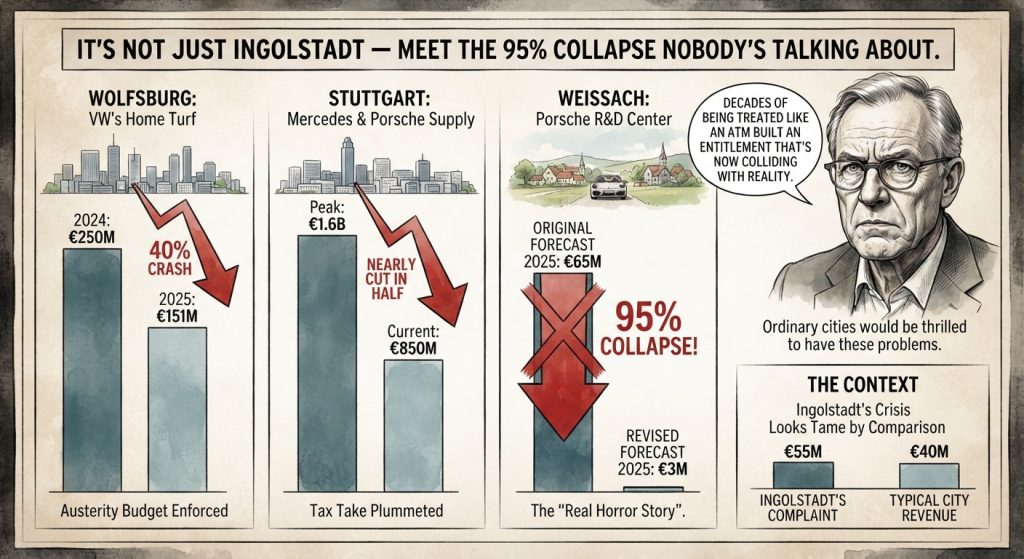
- Wolfsburg, Volkswagen’s home turf, saw its business tax revenue crash 40% in a single year, falling to €151 million — with city officials warning there’s no bottom in sight and forcing an austerity budget.
- Stuttgart, anchored by Mercedes-Benz and Porsche’s supply chain, has seen its business tax take nearly cut in half — from roughly €1.6 billion at its peak to around €850 million.
- Weissach, the small town that hosts Porsche’s development center, is the real horror story: its 2025 business tax forecast started at €65 million and had to be slashed to just €3 million — a collapse of more than 95% in a single budget cycle.
Compared to those numbers, Ingolstadt’s crisis almost looks tame. As one German fiscal researcher put it, plenty of ordinary cities would be thrilled to have the tax revenue Ingolstadt or Wolfsburg are complaining about — but decades of being treated like an ATM built an entitlement that’s now colliding with reality.
The Marble Crosswalks That Became a Monument to Squandered Wealth
If you want a physical symbol of how absurdly rich these towns once were, go to Sindelfingen — Mercedes-Benz’s assembly-plant town in the Stuttgart region, not, as sometimes assumed, a Porsche stronghold. During Sindelfingen’s peak years, when it was routinely cited as one of the wealthiest municipalities in Germany or even Europe, the city paved pedestrian crossings in its center with Carrara marble instead of ordinary painted lines. The logic at the time was almost mundane — marble doesn’t need repainting — but the optics were pure boomtown excess.


Locals still point to those crossings as a landmark. The city itself is now, by local accounts, essentially broke, kept afloat in part by discussions of a merger with neighboring Böblingen. The marble is still there. The money that justified it isn’t.
Germany’s Bigger Problem: The Whole Industrial Model Is Cracking
Zoom out and Ingolstadt looks less like a local anomaly and more like an early warning. Germany’s automotive sector employed 691,500 people at the end of the first half of 2026 — down 42,300 workers, or 5.8%, in just one year, the steepest drop of any major German industrial sector and the lowest headcount since 2005. Parts and component suppliers were hit hardest, shedding 7.6% of their workforce.

Industry association VDA has repeatedly revised its long-term forecasts downward, now projecting well over 100,000 additional automotive jobs could disappear by 2035 without major competitiveness reforms. The causes stacking up are familiar: a collapsing Chinese market that used to be German carmakers’ biggest profit engine, aggressive Chinese EV competition even inside Europe, high energy and labor costs at home, and the expensive, unavoidable shift to electric vehicles.
None of this means Germany’s industrial economy is vanishing overnight. Audi, VW, and Mercedes remain enormous, globally significant companies, and some of the pain reflects a painful but survivable transition rather than terminal decline. But the towns that built their entire fiscal identity around one factory, one brand, one paycheck are discovering just how one-sided that bargain always was.
None of this means Germany’s industrial economy is vanishing overnight… But the towns that built their entire fiscal identity around one factory, one brand, one paycheck are discovering just how one-sided that bargain always was.
Whether these local collapses add up to something bigger for Germany as a whole — or just look that way from ground level — is the question Part 2 of this series tackles next.
The Lesson Nobody Wanted to Learn the Hard Way
Ingolstadt, Wolfsburg, Stuttgart, Sindelfingen, and Weissach spent decades as case studies in industrial prosperity — the kind of places economists pointed to when explaining why Germany’s export-driven, single-industry regional model worked. Now they’re becoming case studies in concentration risk: what happens when a city’s budget, a family’s income, and a region’s identity all depend on the fortunes of one company in one industry.

The marble crosswalks aren’t going anywhere. Neither, realistically, is Audi. But the free money that built one and used to flow from the other is gone — and nobody in Bavaria is quite sure when, or if, it’s coming back.
Does this mean Germany itself — the country that industrialized faster than any other nation in history — is now in terminal decline? That’s a bigger question than one broke city can answer. Part 2 of this series takes it on directly.
- Part 1: Audi Town Is Broke — And the $2 Billion Profit Report Won’t Save It (you are here)
- Part 2: Is Germany Actually Collapsing? What the “Sick Man of Europe” Label Keeps Getting Wrong →
Recommended Reading