

- Part 1: Audi Town Is Broke — And the $2 Billion Profit Report Won’t Save It
- Part 2: Is Germany Actually Collapsing? What the “Sick Man of Europe” Label Keeps Getting Wrong (you are here)
Is Germany Actually Collapsing? The “Sick Man of Europe” Label Has Been Here Before
Broke car towns. Marble crosswalks nobody can afford anymore. A carmaker posting billion-euro profits while its hometown can’t pass a legal budget. If you only read the local horror stories, it’s tempting to reach for the biggest possible frame: is this the beginning of the end for the country that industrialized faster than almost anyone in history, fought two world wars on the back of that industrial machine, and rebuilt itself into Europe’s undisputed economic engine twice in one century?
The honest answer is no — but the reasons why are more interesting than a flat denial. Germany isn’t collapsing. It’s doing something it has done before, on a cycle nobody seems to remember until it happens again.
Germany Has Worn This Label Before — And Shaken It Off
“The sick man of Europe” isn’t a new insult invented for 2026. Germany carried that exact label in the late 1990s and early 2000s, when the country was grinding through the costs of reunification, growing at an anemic 1.2% a year on average between 1998 and 2005, and watching unemployment climb from 9.2% to 11.1%.

Then came the Hartz labor-market reforms of the mid-2000s — a politically brutal package that restructured unemployment benefits, deregulated parts of the labor market, and pushed long-term structural change through a reluctant electorate. It took years to show results. But by the 2010s, after the global financial crisis, Germany had flipped the script entirely: economists were calling it an “economic superstar,” pointing to its resilience during the Great Recession as proof the reforms had worked.
That’s the pattern worth remembering: Germany has gone from sick man to superstar once already, inside a single generation. The label isn’t a diagnosis of terminal illness. It’s a recurring headline that shows up whenever the export-and-manufacturing model hits a rough patch — and it showed up again in 2023 and 2024, when Germany posted back-to-back years of GDP contraction, and it’s being used again now, in 2026, to describe a fifth straight year of near-zero growth.
The Numbers Say “Stagnant,” Not “Collapsing”
Here’s where the historical framing runs into the actual data. Germany’s economy contracted slightly in both 2023 and 2024, and 2025 growth was close to flat. Multiple economic institutes have since cut their 2026 forecasts, with currencurrent projections clustering around 0.8% to 1% growtht projections clustering around 0.8% to 1% growth for the year — weak by Germany’s own historical standards, and weaker than several of its European neighbors, but not a contraction, and nowhere close to a collapse.

Zoom out to where Germany actually sits in the world economy and the “collapse” narrative gets even harder to sustain. As of 2026, Germany remains the third-largest economy on Earth by nominal GDP, at roughly $5.45 trillion — behind only the United States and China, and still ahead of Japan and the UK. GDP per capita sits around $65,000, comfortably inside the world’s top 20. Public debt, at around 60% of GDP, remains low by the standards of major developed economies. None of these are the numbers of a country in economic freefall.
What’s actually happening is closer to relative stagnation: Germany isn’t shrinking, but it’s growing slower than it used to, slower than some of its neighbors, and slower than the scale of its structural problems demands.
So What’s Actually Wrong? The Real List Is Long, But It’s Fixable
The structural problems behind the current slump are real and well documented, even if they don’t add up to collapse:
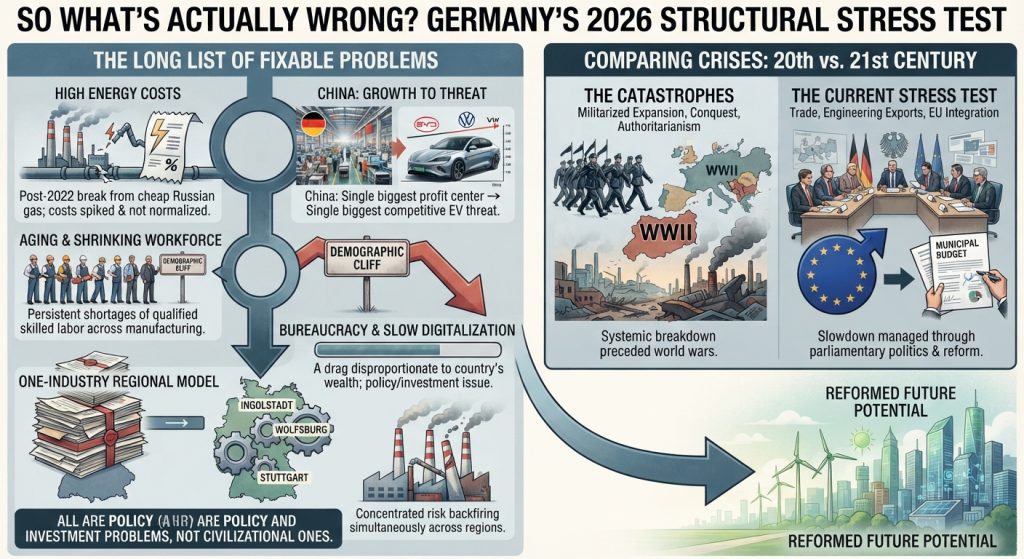
- Energy costs that spiked hard after Germany’s post-2022 break from cheap Russian gas and haven’t fully normalized.
- China, which spent two decades as German industry’s single biggest growth engine and profit center, and has flipped into German carmakers’ single biggest competitive threat — domestic Chinese brands now dominate their own market, and Chinese EV exports are undercutting German models on price even inside Europe.
- An aging, shrinking skilled workforce, with employers across manufacturing sectors reporting persistent shortages of qualified workers.
- Bureaucracy and slow digitalization, cited repeatedly by both German business leaders and outside economists as a drag disproportionate to the country’s wealth.
- A one-industry regional economic model — exactly the Ingolstadt, Wolfsburg, and Stuttgart story from Part 1 — that concentrated risk in ways that are now backfiring simultaneously across multiple regions at once.
Every one of these is a policy and investment problem. None of them is a civilizational one. Compare that to the conditions that actually produced Germany’s two 20th-century catastrophes — militarized industrial expansion inside an authoritarian imperial and then fascist state, pursued through conquest — and the comparison collapses immediately. Modern Germany’s growth engine ran on trade, engineering exports, and EU integration, not territorial expansion, and its current slowdown is being managed through parliamentary politics, coalition negotiations, and municipal budget fights — not the kind of systemic breakdown that preceded either world war.
The More Useful Way to Read the Headlines
If “collapse” is the wrong frame, what’s the right one? Treat this as Germany’s second real stress test of its post-reunification industrial model. The first one — the 1998–2005 stretch — got fixed through a decade of unpopular structural reform that nobody enjoyed while it was happening. There’s no guarantee the current government pulls off the same trick; some economists argue the current mix of problems (energy transition, an aging population, a genuinely formidable Chinese competitor) is harder to reform your way out of than the early-2000s labor market rigidities were.

But “harder problem” and “terminal decline” are not the same claim. Germany’s broke car towns, its stalling GDP growth, and its recycled “sick man” headlines are symptoms of an industrial and fiscal model overdue for restructuring — not evidence that the country that rebuilt itself from rubble twice in the 20th century has simply run out of road. The marble crosswalks in Sindelfingen are a monument to a boom that ended. They’re not a tombstone for the country that built them.
- Part 1: Audi Town Is Broke — And the $2 Billion Profit Report Won’t Save It
- Part 2: Is Germany Actually Collapsing? What the “Sick Man of Europe” Label Keeps Getting Wrong (you are here)
Recommended Reading
The Rhine Is Dead – Europe’s Lifeline Collapses / The Rhine-Danube Drought and Germany’s Economy in 2026