

There’s a blood test that costs less than a large pizza, takes five minutes to draw, and can flag a heart attack risk that a normal cholesterol panel completely misses. It’s called the hs-CRP test — short for high-sensitivity C-reactive protein — and if you’ve never heard of it, you’re not alone.
Here’s why it deserves a spot on your radar.
The Problem With “Normal” Cholesterol

Roughly half of all heart attacks happen in people with cholesterol levels that look perfectly acceptable on paper. That statistic alone should make you uncomfortable. Cardiovascular disease is still the leading cause of death in the United States, and Canada isn’t far behind — yet the standard lipid panel, the test almost everyone gets at their annual physical, is blind to a major driver of the disease: chronic, low-grade inflammation.
That’s the gap hs-CRP test was built to fill.
This isn’t a fringe theory. Dr. Paul Ridker, a preventive cardiologist at Brigham and Women’s Hospital who has spent two decades researching CRP, has argued that hs-CRP test adds prognostic information at every level of LDL cholesterol — not instead of a lipid panel, but on top of it (Medscape interview). If you’ve already had a lipid panel come back “normal” and still want the fuller picture, it’s worth reading Your Blood Test Says You’re “Fine.” Your Arteries Might Disagree.
What the hs-CRP Test Actually Measures
C-reactive protein is made by your liver in response to inflammation anywhere in the body. A basic CRP test has been around for decades, but it’s a blunt instrument — designed to catch acute inflammation like a raging infection or an autoimmune flare, with a measuring range of roughly 10 to 1,000 mg/L.

The “high-sensitivity” version is a different animal. It can detect CRP down to about 0.3 mg/L, which means it picks up the kind of quiet, simmering inflammation that doesn’t make you feel sick but slowly damages the lining of your blood vessels over years. That’s the inflammation implicated in atherosclerosis — the plaque buildup that eventually causes heart attacks and strokes.
The Numbers That Matter
North American cardiology guidelines, going back to a joint 2003 statement from the CDC and the American Heart Association, break hs-CRP test results into three risk bands:

- Under 1.0 mg/L — low cardiovascular risk
- 1.0 to 3.0 mg/L — average (intermediate) risk
- Above 3.0 mg/L — high risk
These cutoffs came out of population data on roughly 40,000 people and have held up remarkably well since. The 2019 ACC/AHA cholesterol guidelines naming the hs-CRP test result at or above 2.0 mg/L went a step further, naming hs-CRP test at or above 2.0 mg/L a “risk enhancer” — a factor that can tip a doctor toward starting statin therapy in patients who are otherwise sitting on the fence.
This isn’t an informal rule of thumb — it’s written into the guidelines. The 2019 ACC/AHA primary prevention guideline formally lists hs-CRP test of 2.0 mg/L or higher as a “risk enhancer” that can tip a borderline patient toward statin therapy, and recommends considering the test specifically in people who sit in the intermediate-risk category (Class 2a recommendation) (Jialal & Devaraj, Therapeutic Advances in Cardiovascular Disease, 2019; full guideline summary, PMC).
If your number comes back above 10 mg/L, don’t panic and don’t assume it’s your arteries — that level almost always points to something acute, like a cold, an infection, or recent injury, and doctors typically ask for a retest a couple of weeks later once you’re feeling normal again.

Who Actually Benefits From This Test
hs-CRP test isn’t meant to replace a lipid panel, and it isn’t something everyone needs. It shines brightest in one specific group: people sitting in the “intermediate risk” zone — roughly a 10–20% estimated 10-year risk of coronary heart disease using standard calculators like the Framingham score. For these people, hs-CRP test can act as a tiebreaker. An elevated result can reclassify someone from intermediate to high risk, which changes the conversation about how aggressively to treat cholesterol.
Ridker’s group has continued to press this point in more recent work. At the 2025 European Society of Cardiology Congress, he presented 30-year data from the Women’s Health Study showing that women with no traditional cardiovascular risk factors but elevated hs-CRP test still had a progressively higher risk of coronary disease and stroke — a group he’s started calling “SMuRFless but inflamed.” His summary of why this matters in practice: <cite index=”4-1″>”until we tell physicians inflammation matters, they will not measure it”</cite> (TCTMD coverage, ESC 2025).
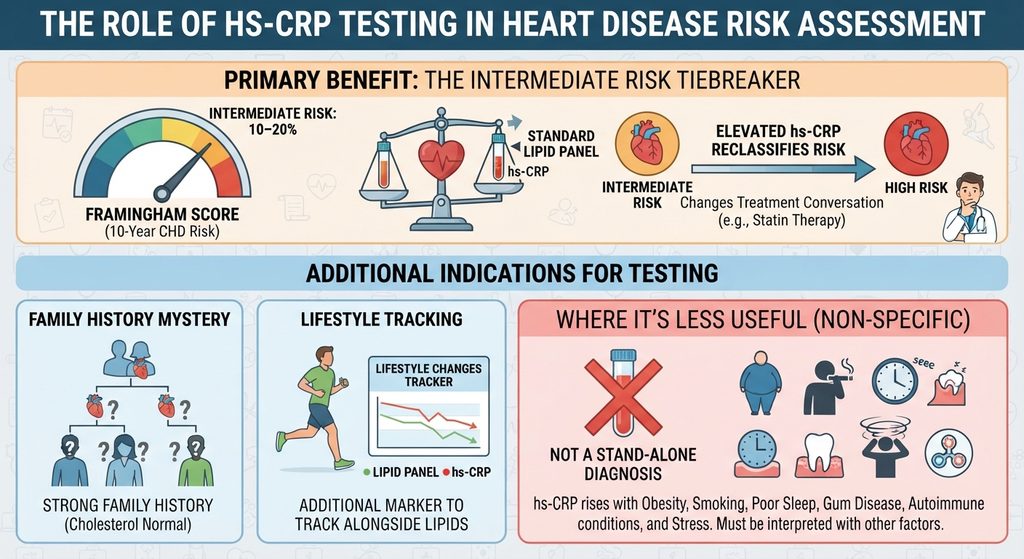
It’s also relevant if you have a strong family history of heart disease but your cholesterol numbers don’t explain it, or if you’re already making lifestyle changes and want an additional marker to track alongside your lipids.

Where it’s less useful: as a random add-on test with no clinical question behind it, or as a stand-alone diagnosis of anything. hs-CRP test is non-specific — it rises with obesity, smoking, poor sleep, gum disease, autoimmune conditions, and plain old stress, not just heart disease. That’s exactly why it’s interpreted alongside your other risk factors, not in isolation.
Why This Matters More Than People Realize

The evidence base isn’t small. Researchers have tracked hs-CRP test against future cardiac events in well over twenty separate study populations, and the association holds up even after adjusting for the traditional risk factors — cholesterol, blood pressure, diabetes, obesity, smoking. In patients who already have coronary artery disease, even values in the 1–3 mg/L range are linked to meaningfully worse outcomes down the line.
The strongest single piece of evidence here is probably the JUPITER trial, published in the New England Journal of Medicine in 2008. Ridker and colleagues randomized over 17,000 people with normal LDL but elevated hs-CRP test (≥2.0 mg/L) to rosuvastatin or placebo; the statin group saw a 44% relative reduction in major cardiovascular events (Ridker et al., NEJM 2008). More recent data reinforces the same idea: a 2023 meta-analysis of over 31,000 statin-treated patients across the PROMINENT, REDUCE-IT, and STRENGTH trials found that elevated hs-CRP test predicted future cardiovascular events and mortality more strongly than LDL cholesterol did (Brigham and Women’s Hospital / HCPLive coverage, AHA 2023).

That said, hs-CRP test hasn’t earned the highest tier of clinical recommendation (it’s Class IIa/IIb — “reasonable to consider,” not “must-do”), mainly because no large randomized trial has definitively proven that lowering CRP itself, rather than the underlying risk factors driving it, improves outcomes. Statins lower both LDL cholesterol and CRP simultaneously, which makes it hard to fully separate the two effects. Science is still working that part out.
The Bottom Line
If your cholesterol panel looks fine but you have a family history of heart disease, sit in that murky “maybe I need a statin, maybe I don’t” middle ground, or just want a fuller picture of your cardiovascular risk, ask your doctor about the hs-CRP test to your next blood draw. It’s inexpensive, it’s covered by most North American health plans or available cheaply through direct-to-consumer lab services, and it might catch something a cholesterol number alone never will.

Your heart doesn’t wait for your LDL to look bad before it starts having problems. Sometimes the warning sign is inflammation — quiet, unmeasured, and easy to miss unless you know to look for it.
This article is for informational purposes only and is not a substitute for professional medical advice. Talk to your healthcare provider about whether hs-CRP testing is appropriate for you.
External link summary
Ridker PM et al. Rosuvastatin to Prevent Vascular Events in Men and Women with Elevated C-Reactive Protein (JUPITER trial). NEJM, 2008. https://www.nejm.org/doi/full/10.1056/NEJMoa0807646
2018/2019 ACC/AHA Multisociety Cholesterol Guideline highlights, PMC. https://pmc.ncbi.nlm.nih.gov/articles/PMC6783658/
High-sensitivity CRP in ASCVD: To Measure or Not to Measure? (2024 review). https://pmc.ncbi.nlm.nih.gov/articles/PMC11959579/
TCTMD: High hs-CRP test Linked to More CVD Events in Women Lacking Traditional Risk Factors (ESC 2025). https://www.tctmd.com/news/high-hs-crp-linked-more-cvd-events-women-lacking-traditional-risk-factors
HCPLive: Inflammation Could Be Better Predictor of Cardiovascular Events than LDL-C (AHA 2023). https://www.hcplive.com/view/new-aha-23-data-further-highlights-role-of-inflammation-in-cardiovascular-risk
Ridker PM. High-sensitivity C-reactive protein, inflammation, and cardiovascular risk (review). Am Heart J, 2004. https://pubmed.ncbi.nlm.nih.gov/15211329/