

- Part 1 — Is Germany Actually Collapsing? The “Sick Man of Europe” Label Has Been Here Before
- Part 2 — Audi Town Is Broke, and the $2 Billion Profit Report Won’t Save It
- Part 3 — Germany’s Rivers Just Hit a 146-Year Low (you are here)
Also related: The Bond Market’s Ultimatum — how surging Treasury yields are compounding pressure on global growth this quarter.
Germany’s Rivers Just Hit a 146-Year Low — And They’re Draining the Economy With Them
Part 3 of THE CORE INSIGHT’s series on Germany’s industrial crisis. Part 1 asked whether Germany is actually collapsing, and Part 2 walked through why Audi’s hometown went broke even as the automaker posted billion-euro profits. This installment covers a different kind of stress test — one written in centimeters of missing water.
Picture a barge captain on the Rhine this August, watching sunbathers stretch out on riverbed that hasn’t seen daylight in generations. He isn’t loading cargo. He’s turning his boat around, because there isn’t enough water left to float it.
The Rhine Just Broke a Record That Stood Since 1880
Start with the number that should stop you: at Kaub, the Rhine’s most-watched bottleneck between Koblenz and Frankfurt, the navigable water depth cratered to roughly 9–15 centimeters in early-to-mid August 2026 — below the previous all-time low of 25 cm set in 2018, and the lowest reading since river-gauge records began in 1880, according to Bloomberg and CNN’s satellite analysis. Germany’s own Federal Institute of Hydrology confirmed average flow rates hit their lowest point in more than three decades across 85% of the river.

This isn’t a scenic curiosity. The Rhine is the circulatory system for the industrial heartland of Europe’s largest economy — a roughly 1,230-kilometer waterway running from the Swiss Alps through Germany’s chemical, steel, and auto corridor to the Netherlands’ port of Rotterdam. It carries only about 5–6% of Germany’s total freight tonnage, but that sliver happens to be coal, diesel, chemical feedstock, and the oversized industrial components — like Siemens Energy turbines — too heavy for rail or road to move at all. When the river can’t carry them, there frequently is no Plan B.
With barges unable to load fully, some operators have been running at a fraction of normal capacity, and vessels able to sail at all have had to cut their loads sharply just to clear the shallows. Chemical maker Evonik Industries put it plainly, saying the low water was restricting inland shipping capacities and posing major challenges for logistics and supply chains, and confirmed it was shifting freight to rail and road. BASF, Thyssenkrupp, and Lanxess have all reported supply-chain strain, and utility EnBW estimated the disruption would cut its earnings by a low double-digit millions of euros, per Bloomberg’s reporting.
Why You Can’t Just “Put It on a Truck”
The obvious question is why Germany doesn’t simply reroute cargo to rail and highways when the river runs dry. The honest answer: it’s trying to, and it isn’t nearly enough. Rail capacity in Germany is already tight, and there’s a persistent shortage of truck drivers across the EU. Several German states have temporarily lifted Sunday and holiday driving bans specifically to free up truck capacity for low-water replacement traffic — a stopgap, not a fix, and one most states have already scheduled to expire by the end of September, according to freight-industry tracking from Freight Perspectives.

For the heaviest industrial cargo — components weighing 100 to 300 tonnes — there is no realistic road or rail alternative at any price. That’s why manufacturers built plants on the riverbank in the first place. When the Rhine closes, that supply chain doesn’t slow down; it stops.
The GDP Math, According to the People Whose Job It Is to Know
This is where it stops being an infrastructure story and becomes a portfolio story. The Deutsche Bundesbank, Germany’s central bank, addressed the drought directly in its official August 2026 Monthly Report, warning that constrained river transport and sharply rising freight costs were likely to significantly impair industrial production and export growth — enough, the bank said, that the fragile recovery underway in German industry would see at best only a slight uptick in third-quarter growth.
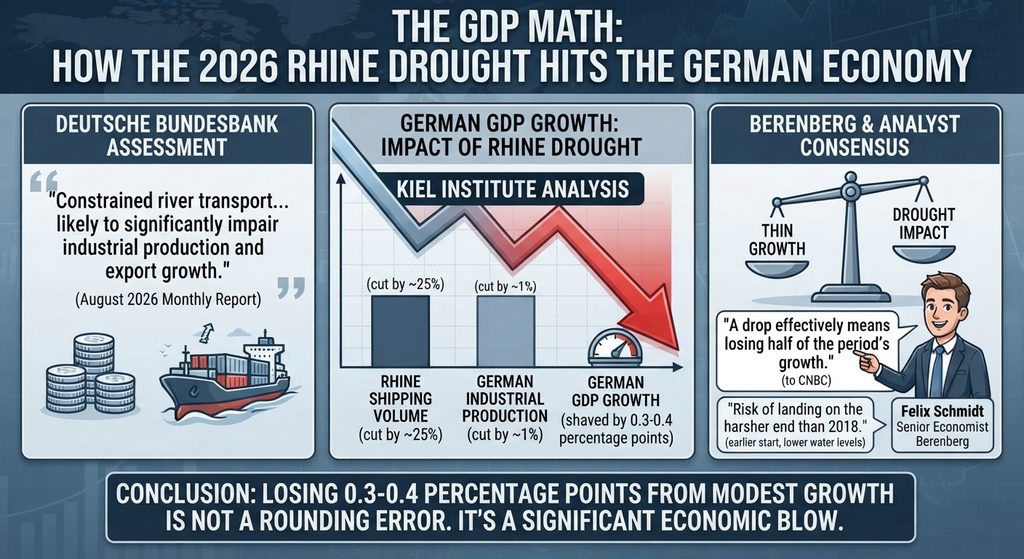
That’s not a one-off alarm. The Kiel Institute for the World Economy, one of Germany’s most-cited independent economic research bodies, has published peer-reviewed analysis showing that a full month of Rhine levels below the 78-cm navigability threshold at Kaub cuts German industrial production by roughly 1%, and shipping volumes by around a quarter — a combination that shaved close to 0.3 to 0.4 percentage points off German GDP growth during the comparable 2018 drought. Given that most forecasters had already penciled in only modest German growth for 2026, losing even a third of a point is not a rounding error.
Felix Schmidt, a senior economist at the German private bank Berenberg, framed the stakes bluntly to CNBC: with growth already this thin, a drop for the quarter effectively means losing half of the period’s growth. Analysts at ING and elsewhere have echoed that this year’s disruption—arriving earlier in the summer and hitting a lower absolute water level than in 2018—carries a real risk of landing on the harsher end of that historical range.
Meanwhile, on the Danube: Europe Turned Off Its Own Nuclear Power
If the Rhine story is about logistics, the Danube story is about something more visceral: keeping the lights on. Nuclear reactors need enormous volumes of river water for cooling, and 2026’s drought pushed three countries’ reactors to the brink simultaneously.
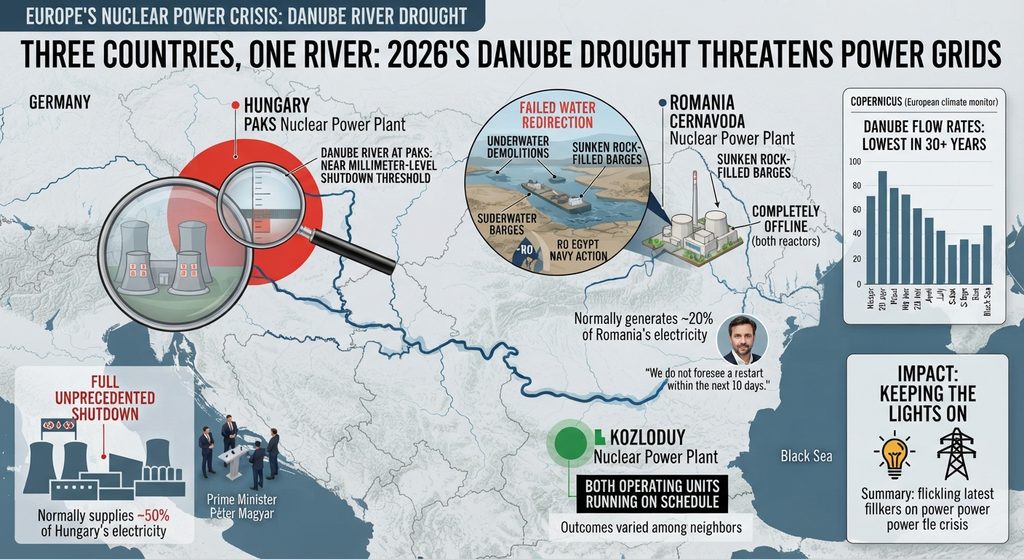
- Hungary’s Paks plant — which normally supplies close to half the country’s electricity — was forced into a full, unprecedented shutdown, the first in its 44-year operating history, after the Danube fell to record lows. Prime Minister Péter Magyar told reporters the complete shutdown of the Paks power plant could take place today, or perhaps tomorrow, according to Euronews. At one point the river came within millimeters of the shutdown threshold before a small rebound kept a single turbine online.
- Romania’s only nuclear plant, Cernavoda, which normally generates about a fifth of the country’s electricity, went completely offline in mid-August after both of its reactors were taken down in stages. Plant director Romeo Urjan told AFP we do not foresee a restart within the next 10 days, as reported by Al Jazeera. Romania’s navy resorted to underwater demolitions and sunken rock-filled barges in a failed attempt to redirect enough water to keep the plant’s cooling system running.
- Bulgaria’s Kozloduy plant, by contrast, kept both operating units running on schedule — a reminder that outcomes varied significantly even among neighboring countries drawing on the same river.
The independent European climate monitor Copernicus found that flow rates across nearly two-thirds of the Danube fell to their lowest levels in more than thirty years this summer, per Al Jazeera’s reporting — context that makes clear this wasn’t a localized fluke at one plant, but a basin-wide event.
This Keeps Happening — and It’s Arriving Earlier Each Time
Germany saw comparable Rhine disruption in 2018 and again in 2022. What’s different in 2026, according to multiple independent trackers, is timing and depth: the 2018 record wasn’t broken until October, near the seasonal low point; in 2026, Kaub broke that record in early August, weeks ahead of the historical worst-case window, per chemical-industry trade coverage from C&EN. That earlier onset matters economically, because it means the disruption window — and the associated freight-cost spike — simply runs longer.

Hydrologist Massimiliano Zappa of the Swiss Federal Institute for Forest, Snow and Landscape Research attributed the compounding shortfall to low winter Alpine snowpack layered under five separate summer heatwaves across the Rhine basin, as he told CNN. In other words: this is less a single freak summer than a pattern building on itself year after year — and each repetition tests whether shippers, insurers, and utilities have actually built in more resilience since the last one, or just gotten better at managing the same recurring shock.
Where Things Stand Right Now

As of the third week of August, the picture is a partial, grinding recovery rather than a resolution. Germany’s Federal Institute of Hydrology’s own forecasting puts Kaub on track for a modest rise through September — from a weekly average in the mid-20-cm range toward roughly 100 cm by late September — but explicitly flags that levels could remain below normal navigability well into the autumn, per Freight Perspectives’ tracking of the official forecast. On the Danube, Hungary’s Paks plant has avoided a repeat full shutdown for now, but is still running well below normal capacity, and both governments have signaled the underlying vulnerability — thin river margins cooling reactors and floating industrial cargo alike — isn’t going away with one good rainstorm.
What This Means If You’re Reading This With an Eye on Retirement

You don’t need a position in a German barge operator to feel this. A slower German industrial recovery ripples into European equity funds, into the earnings of multinational chemical and auto suppliers many U.S. and Canadian index funds hold indirectly, and into European energy prices at exactly the time nuclear output is being pulled offline for reasons that have nothing to do with policy or fuel costs. If you hold international or European-tilted funds inside an IRA, RRSP, or diversified retirement sleeve, this is a genuine — if modest — headwind worth knowing about rather than a reason to panic-sell anything. The bigger, quieter lesson is one climate economists have been making for years: infrastructure built for a climate that no longer exists creates recurring costs that show up in growth forecasts and utility bills long after the news cameras leave the riverbank.
Further reading on THE CORE INSIGHT:
- Part 1: Is Germany Actually Collapsing? The “Sick Man of Europe” Label Has Been Here Before
- Part 2: Audi Town Is Broke — And the $2 Billion Profit Report Won’t Save It
- The Bond Market’s Ultimatum, Part 1: What the 10-Year Treasury Is Really Telling Us
Primary sources & data used in this article:
- Deutsche Bundesbank, Monthly Report — August 2026
- Kiel Institute for the World Economy — working paper on Rhine low-water levels and German economic activity (PDF)
- Bloomberg — Rhine Set for More Disruption After Hitting Lowest Water Level on Record
- CNN — Extreme weather is drying up Europe’s rivers in a crisis so dire it can be seen from space
- CNBC — Nuclear power plants are being shut down as Europe’s drought becomes an energy crisis
- Al Jazeera — Falling Danube flow forces shutdown of Romania’s sole nuclear plant
- Euronews — Hungary’s Paks nuclear plant faces shutdown as Danube water levels hit record low
- Freight Perspectives — Rhine Water Levels 2026: Kaub Gauge & Road Freight Impact
This article is for general informational purposes and does not constitute financial advice. Data and figures reflect reporting available as of late August 2026 and may change as river conditions evolve.
- Part 1 — Is Germany Actually Collapsing? The “Sick Man of Europe” Label Has Been Here Before
- Part 2 — Audi Town Is Broke, and the $2 Billion Profit Report Won’t Save It
- Part 3 — Germany’s Rivers Just Hit a 146-Year Low (you are here)
Also related: The Bond Market’s Ultimatum — how surging Treasury yields are compounding pressure on global growth this quarter.