
Series: 2026 Bond Market Crisis
The Treasury’s Band-Aid, and the History of Bond Market Discipline
This is Part 2 of a three-part series. Part 1 covered why long-term Treasury yields are surging and why it’s a fiscal story more than an inflation story. Part 3 covers the fallout for stocks, the AI trade, and what investors should do about it.
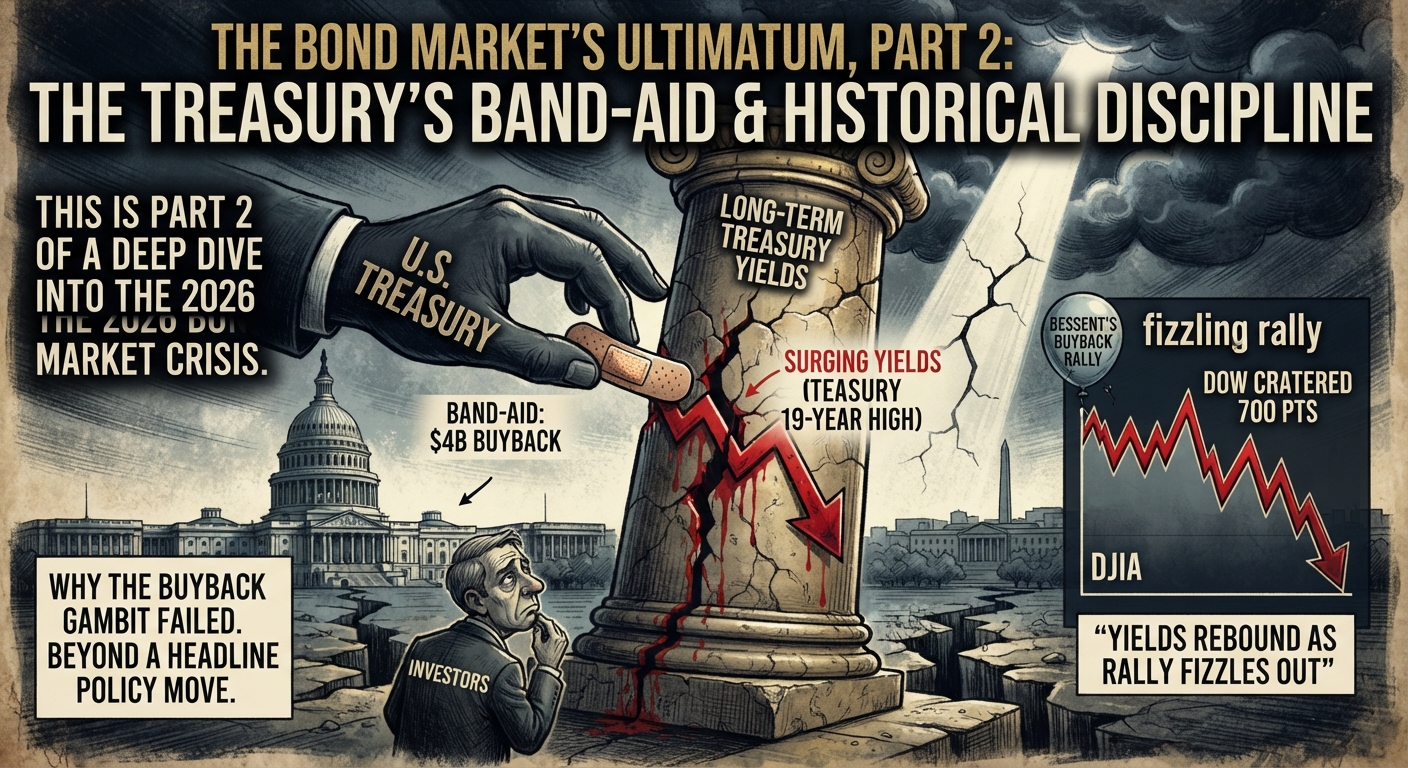
Faced with a bond market that seemed to be losing patience, the U.S. Treasury did what governments under pressure usually do: it announced an intervention. In late August 2026, the Treasury said it would at least double the size of its buyback program for long-maturity securities — reportedly to $4 billion or more per quarter, according to Treasury Secretary Scott Bessent, covering bonds with maturities from 10 to 30 years.
For about a day, it worked. Yields dipped. Then they rebounded and erased the entire move — while the Dow Jones Industrial Average fell roughly 700 points that same week on doubts that the plan would actually address the underlying problem. Longer-dated yields, as one market recap put it bluntly, rose again “as Bessent’s bond buyback rally fizzles out.”
To understand why a headline-grabbing policy move produced essentially nothing, you have to understand what a buyback actually is — and isn’t.
What a Treasury buyback actually does

A “buyback” means the U.S. Treasury repurchases bonds it already issued in the past and that are now trading in the secondary market. For example: a 10-year note sold three years ago, now with seven years left until maturity, gets bought back by the Treasury before its scheduled maturity date. This can modestly increase demand for existing bonds and put some downward pressure on their yields.
But there’s a catch that undermines the whole exercise: the Treasury needs cash to do the buying. Governments raise money two ways — taxation and new bond issuance. The reason U.S. government debt keeps climbing in the first place is that issuance has consistently outpaced revenue. So when the Treasury wants cash for a buyback, and it isn’t raising taxes or cutting spending to get it, that cash typically comes from issuing more short-term debt.

Follow the logic through: the government borrows short-term money to buy back long-term debt. The total pile of liabilities on the government’s books doesn’t shrink by a single dollar — it just gets rearranged, with more of it now sitting in shorter maturities. It’s a maturity swap, not debt reduction. Markets, unsurprisingly, aren’t fooled for long, which is exactly what the “fizzle” in yields within 24 hours of the announcement demonstrated.
Why this isn’t the same as 2008-era QE — even though it looks similar on paper
The comparison to quantitative easing (QE) after the 2008 financial crisis comes up constantly, and it’s worth being precise about why the two are fundamentally different tools.
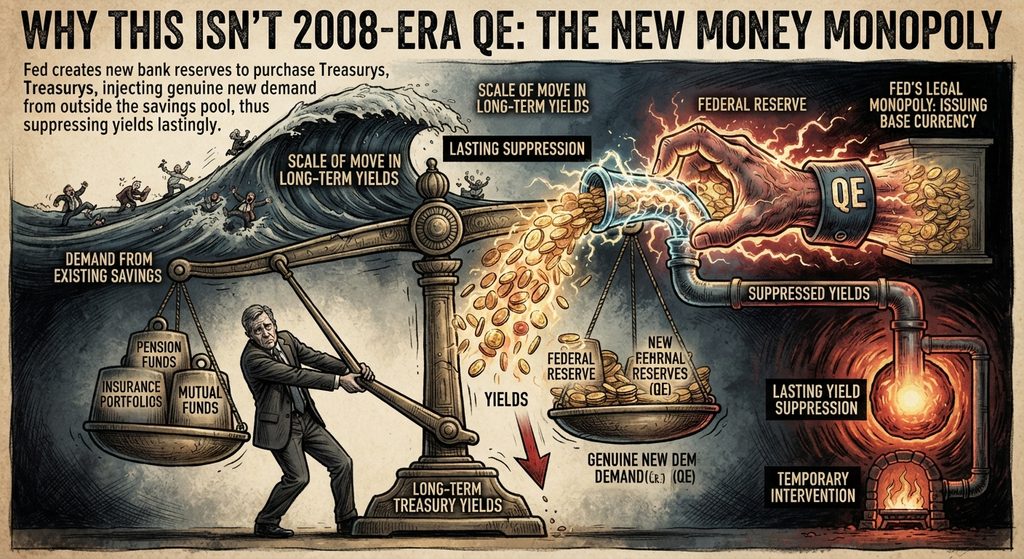
When the Federal Reserve conducted QE, it created new bank reserves — effectively new money — to purchase long-term Treasury bonds. Because the Fed holds an exclusive, legal monopoly on issuing the base currency, this kind of purchase genuinely injects new demand into the bond market from outside the existing pool of savings. That’s precisely why it can suppress yields in a way that lasts.

A Treasury buyback, funded by issuing other government debt, has no such power. It’s the government moving money between its own accounts, not a central bank injecting new liquidity into the system. Textbook economics generally cautions against central banks trying to override market-determined long-term rates in the first place — and yet, after both the 2008 crisis and the 2020 pandemic, most major central banks did exactly that when conditions were severe enough. Even so, economists broadly agree that central-bank-financed purchases and government-financed buybacks are not equivalent tools, which is a large part of why the Treasury’s late-August announcement produced a rally that lasted less than a day.
The clearest recent lesson: what happens when a government pushes the bond market too far
If you want a vivid case study of what happens when bond investors decide a government’s fiscal math doesn’t add up, look no further than the United Kingdom in September 2022.

Prime Minister Liz Truss’s government announced a package combining large, unfunded tax cuts with continued high government spending — essentially asking the bond market to finance a bigger deficit on faith. The market’s answer came within days: UK gilt yields spiked sharply, the pound sold off hard against the dollar, and pension funds using leveraged liability-driven investment strategies faced margin calls severe enough that the Bank of England had to step in with emergency bond purchases just to prevent a broader financial-stability crisis. Truss resigned after 44 days in office — the shortest tenure of any prime minister in modern British history.
The episode has become the textbook reference point for a simple truth: the bond market can discipline a government’s fiscal policy faster and more brutally than any domestic political institution. No amount of political mandate overrides it once investors decide the debt trajectory is unsustainable.
How 2008 and 2020 quietly rewrote the rules
To understand why the world has reached a point where central banks and treasuries routinely intervene in markets that were once left to their own devices, it helps to trace two pivotal turning points.

2008: the line gets crossed. When Lehman Brothers collapsed in September 2008, the U.S. financial system faced its deepest contraction since the Great Depression. In the aftermath, investment banks like Goldman Sachs and Morgan Stanley converted themselves into bank holding companies — a structural move made specifically so they could access Federal Reserve emergency lending facilities that had previously been reserved for traditional commercial banks. Strict free-market logic would have let over-leveraged institutions like Lehman and AIG fail outright. Instead, the safety net expanded to cover institutions and activities the Fed had never covered before. That was the first major expansion of the central bank’s footprint into private-market rescue operations.

2020: the line moves again. The COVID-19 pandemic pushed the Fed further still, extending support directly to private, non-financial corporations through emergency lending facilities — a degree of intervention that would once have been considered a clear departure from free-market principles, where profits and losses are supposed to be earned through competition, not backstopped by the central bank. Around the same period, intensifying U.S.-China strategic competition began reshaping how policymakers — and even Silicon Valley executives who once championed pure market competition — talk about industrial and technology policy, increasingly in explicitly national-security terms.

Japan: the preview of where this can lead. Japan offers the longest-running real-world experiment in this dynamic. During its “lost decades,” chronically weak private-sector demand was met with sustained government fiscal expansion, financed in large part through the Bank of Japan’s own purchases of government debt. The result: Japan’s general government debt-to-GDP ratio now sits somewhere between roughly 190% and 235%, depending on which measure you use (narrower central-government figures run lower; broader IMF estimates run higher) — among the highest of any major economy on earth, and the clearest available preview of what a multi-decade fiscal expansion looks like when a central bank keeps absorbing the resulting debt.
Put together, these episodes describe a steady expansion of the “visible hand” — central banks and governments — into territory once governed almost entirely by market forces. That’s the backdrop against which today’s Treasury buyback should be read: not as an isolated policy tweak, but as the latest small move in a two-decade trend of state and central-bank involvement in markets. The bond market’s muted, skeptical reaction to it suggests investors understand the difference between that trend continuing at the margins, and it actually solving the underlying fiscal problem.
Setting up Part 3
None of this happens in a vacuum. A structural shift in how governments and central banks interact with markets also changes how stocks and bonds behave relative to each other — and it lands with particular force on the corner of the market that has powered most of this cycle’s gains: AI infrastructure spending, financed increasingly with debt. Part 3 covers exactly how exposed that trade is, what’s actually different about stock-bond correlation since 2008, and what disciplined investors should be doing with this information right now.
Continue to Part 3: “Who Gets Hurt First — and What to Do About It.”
Series: 2026 Bond Market Crisis