
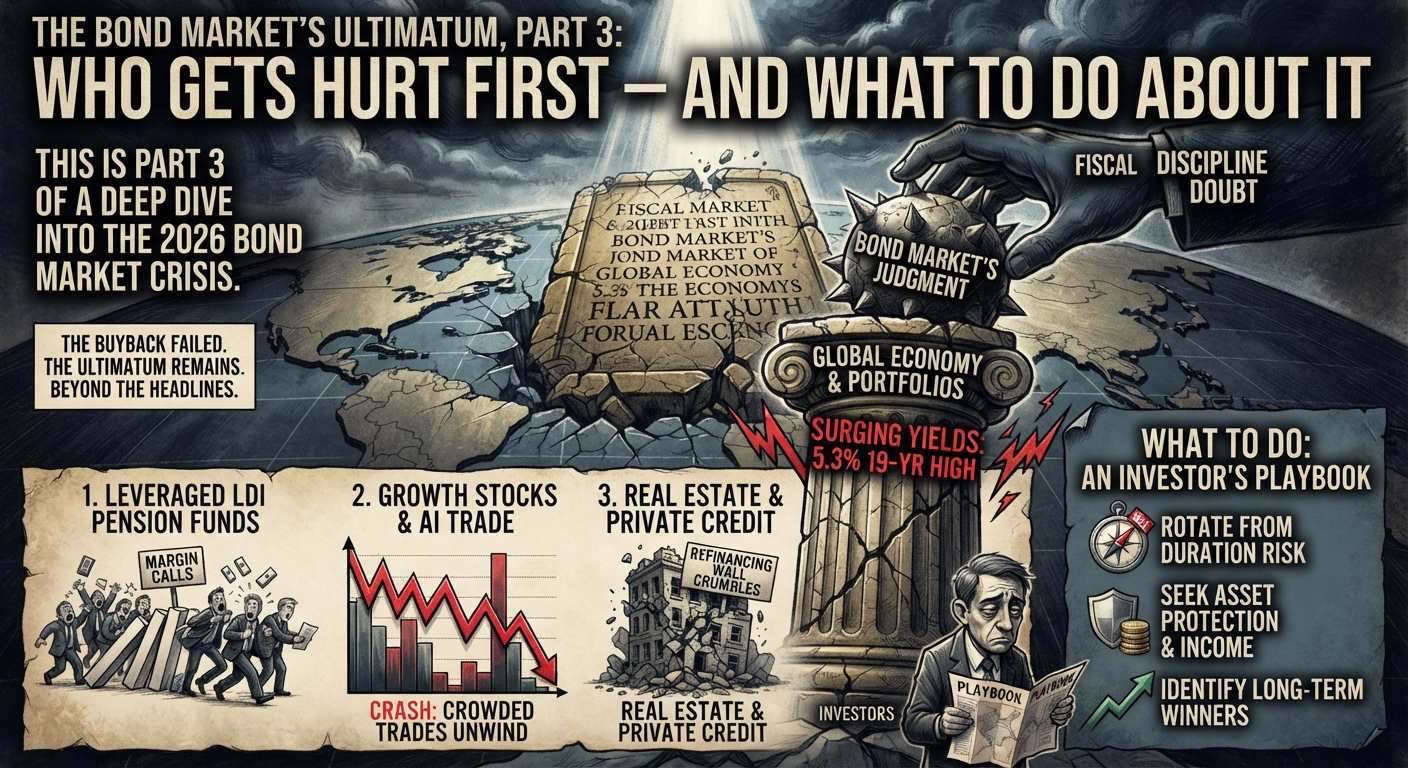
Series: 2026 Bond Market Crisis
This is Part 3 of a three-part series. Part 1 covered why long-term Treasury yields are surging as a fiscal-risk signal rather than an inflation story. Part 2 covered the Treasury’s buyback response and the historical playbook for bond-market discipline.
Who Gets Hurt First — and What to Do About It
The first two parts of this series made the case that rising long-term Treasury yields are less about an overheating economy and more about the bond market pricing in doubt over government fiscal discipline — a doubt that Washington’s buyback maneuver hasn’t meaningfully resolved. The question this final part answers is simple: so what? Who actually gets hurt if this continues, and what should an investor watching from the sidelines actually do?
The diversification promise that quietly broke

For decades, the standard advice for a balanced portfolio was some version of 60% stocks, 40% bonds. The logic: when stocks fall — usually because growth expectations sour — bonds tend to rise, because investors flee to safety and central banks typically cut rates to support the economy. That inverse relationship was the backbone of modern portfolio construction.
Janus Henderson, 95-year : analysis of joint stock-bond declines
Morgan Stanley Investment Management, “The Big Picture: Return of the 60/40“

Before 2008, that relationship held reasonably well. Since the crisis, it’s become far less reliable — and in the specific case of rate-driven selloffs, it has flipped entirely. In 2018 and again in 2022, sharp increases in long-term yields coincided with broad-based declines in both stocks and bonds simultaneously. The diversification benefit investors were counting on simply failed to show up in the moments they needed it most, because in both episodes, the culprit wasn’t a growth scare that bonds could hedge against — it was rising rates themselves, which mechanically hurt bond prices while also compressing the valuations investors were willing to pay for future stock earnings.
If the current fiscal-driven yield surge follows that same script — and the early signs, including the Dow’s 700-point drop the same week Treasury yields resumed climbing, suggest it might — portfolios still built on the old 60/40 assumption could be caught flat-footed exactly when protection matters most.
The epicenter: AI infrastructure debt
If one corner of the market is uniquely exposed to this dynamic, it’s the technology companies leading the artificial-intelligence infrastructure buildout — and the numbers involved are large enough to matter for the entire economy, not just the tech sector.

Morgan Stanley estimates global AI-related debt issuance will reach roughly $570 billion in 2026, with about $236 billion already priced by the end of May — nearly four times the pace of a year earlier. Goldman Sachs separately estimated that $489 billion of AI-related debt supply had already come to market this year as of a recent research note, well above its full-year 2025 estimate of $322 billion. The five largest U.S. hyperscalers — Alphabet, Amazon, Meta, Microsoft, and Oracle — issued approximately $121 billion in corporate bonds in 2025 alone, more than four times their 2020–2024 annual average of roughly $28 billion.
The pattern shows up company by company. Oracle’s long-term debt jumped from about $96 billion to roughly $149 billion in a single fiscal year, driven by an aggressive AI infrastructure raise; Barclays downgraded Oracle’s debt outlook in late 2025, warning it could approach the lowest rung of investment-grade. Alphabet issued $20 billion in bonds in February — including a rare 100-year sterling-denominated bond — while lifting its 2026 capital-expenditure guidance to as much as $195–205 billion. Meta has reportedly been preparing a roughly $12 billion special-purpose-vehicle financing for a single Texas data center, and by mid-2026 bond investors were already demanding meaningfully higher yields on Meta’s newest data-center debt than they had just nine months earlier — a direct, real-time readout of rising financing costs hitting the AI trade.
Global Finance Magazine – “Alphabet Taps Debt Markets With 100-Year Issuance“
Forbes, on BlackRock/Blue Owl’s stake in the El Paso data center

This matters for a structural reason: these companies generate enormous free cash flow, but the scale of the buildout has outpaced what internal cash flow alone can fund. Consensus estimates cited by Bank of America show AI capital expenditure consuming roughly 94% of hyperscaler operating cash flow (after dividends and buybacks) in 2025 and 2026, up from about 76% in 2024 — a trajectory that leaves less room to absorb higher borrowing costs without either slowing the buildout or taking on materially more debt.
Yahoo Finance, “Bank of America Just Issued a Stark Warning: The AI Boom Is Hitting a Cash Crunch“

When long-term Treasury yields rise, they don’t just make government borrowing more expensive — they raise the benchmark rate against which all long-duration corporate debt gets priced, hyperscaler bonds included. Given how much of the broader market’s performance over the past two years has been concentrated in AI-related names, a sustained rise in the cost of capital for exactly this group of companies carries systemic weight well beyond the technology sector.
UBS strategist Matthew Mish‘s counterpoint — his named interview arguing a junk-rating downgrade is “highly unlikely.” Citing both sides strengthens credibility.
Yahoo Finance, coverage citing Lynam’s research note
A word on the yen-carry-trade fear — and why it’s probably overstated
Any discussion of global rate stress eventually surfaces worries about a disorderly unwind of yen-carry trades — strategies that borrow cheaply in yen to fund investments in higher-yielding assets elsewhere. It’s worth being clear-eyed here: the leap from “interest-rate differentials are shifting” to “a systemic global liquidation is coming” is a large one, and the more grounded read is a broader, gradual adjustment in currency values — including the possibility that a sustained moderation in dollar strength benefits non-dollar assets on the margin — rather than a single dramatic unwind event. It’s a risk worth monitoring, not a base case worth trading around.
The investor playbook
None of this argues for panic. Bond markets sending a warning is not the same thing as a crisis being imminent, and elevated yields have coexisted with functioning markets for long stretches of history. But it does argue for specific, actionable discipline:

Keep leverage in check. In an environment where the cost of capital is being repriced upward by the market itself — not just by central bank policy — overleveraged positions, whether in a portfolio or a balance sheet, are the first to break when financing costs rise.

Favor balance-sheet quality over growth-at-any-cost. Companies and assets with strong, self-funding cash flow and manageable debt loads are far better positioned to absorb a higher discount-rate environment than those relying on continuous refinancing — a distinction that matters increasingly within the AI trade itself, where financing structures vary widely company to company.
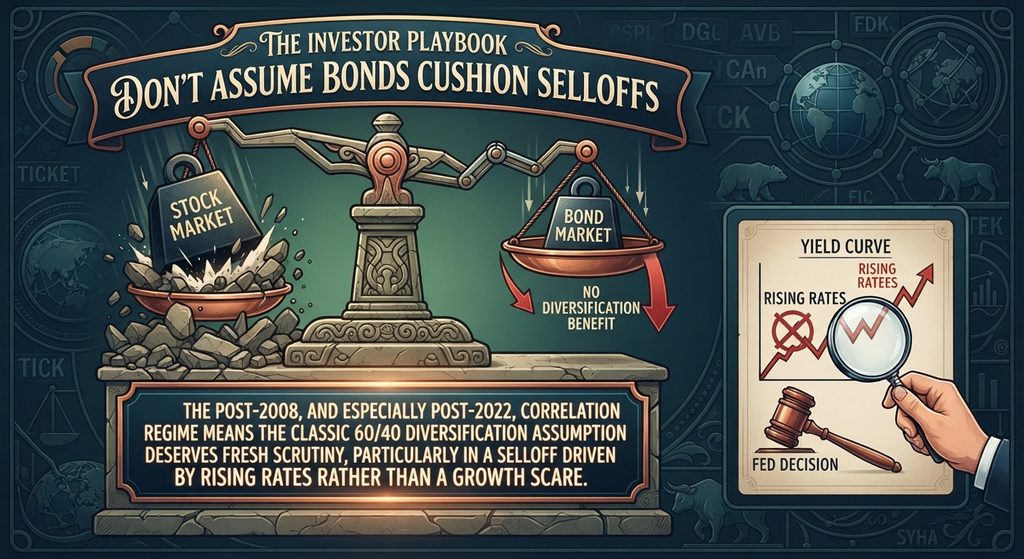
Don’t assume bonds will cushion a stock selloff. The post-2008, and especially post-2022, correlation regime means the classic 60/40 diversification assumption deserves fresh scrutiny, particularly in a selloff driven by rising rates rather than a growth scare.

Watch the long end of the curve, not just the Fed’s next decision. Headlines will keep focusing on whether the Fed hikes or holds in September. The more important signal is what the 10-year and 30-year yields do regardless of that outcome, because they’re responding to a fiscal story that a single rate decision can’t resolve.

Size positions for the world you’re actually in. A market where stock and bond returns can arrive correlated, and where a chunk of index performance sits on debt-financed capital spending, calls for smaller position sizes and more cash buffer than a market where diversification reliably works.
The bottom line

What’s unfolding in the Treasury market isn’t a technical anomaly confined to bond traders — it’s the market doing what it has always done: pricing in doubt about a borrower’s fiscal discipline, and doing so loudly enough that the tremors are now reaching corporate bond desks, mortgage calculators, and the AI infrastructure trade that has powered much of this market cycle. The Treasury’s buyback maneuver demonstrated the limits of what a government can do to quiet that doubt without actually changing its underlying fiscal trajectory — through higher revenue, lower spending, or faster growth. Until that trajectory changes, the pressure on long-term rates is likely to persist. The bond market has already delivered its verdict. What fiscal and monetary authorities — and individual investors — do in response is the story that’s still being written.
Series: 2026 Bond Market Crisis