

Series: 2026 Bond Market Crisis
This article is the prologue to our four-part series, “The 2026 Bond Market Crisis”
Forget the Fed. The real threat to your money isn’t sitting in a marble building in Washington making headline rate decisions eight times a year. It’s happening in a market most investors never think about — and it just fired a warning shot the size of a howitzer.
The 10-year U.S. Treasury yield has rocketed to a 20-month high near 4.75%. The 30-year bond — the one baked into your mortgage math — blew past levels unseen in 19 years, briefly topping 5.3%. And according to Bloomberg’s latest survey of nearly 400 market professionals, two out of three now believe the 10-year is about to smash through 5% before the year is out. That’s a number the market has barely touched since 2007 — the year before everything fell apart.
Make no mistake: this is not a routine wobble. This is the bond market putting a gun on the table.
The number nobody’s watching is the one that can actually wreck you

Everyone’s obsessed with the Fed’s headline rate. It’s the wrong obsession. The number quietly reshaping the entire economy is buried further out on the curve — the 10-year and 30-year yields — and it’s coming for everything: your mortgage, your company’s borrowing costs, and the trillion-dollar debt-fueled AI data-center boom that’s been propping up the stock market. When these yields rip higher, the cost of money explodes everywhere at once, all at the same time, with almost no warning.
This isn’t inflation. This is a credibility crisis.
Here’s what should really scare you: the U.S. economy isn’t even overheating. Growth is mixed at best. Yes, oil-driven inflation tied to the Iran conflict has investors on edge — futures markets have, at points this summer, priced in an eye-popping 80% chance of a September Fed rate hike as crude threatened $100+ a barrel. But that’s a geopolitical shock, not a booming economy running out of control.

So if it’s not overheating and it’s not a runaway boom, what is driving this? Bond investors are staring at Washington’s spending habit and asking a brutally simple question: can this government actually be trusted to pay its debts back? And they’re charging a steeper premium for the privilege of finding out. This isn’t just an American problem, either — the UK, Germany, and Japan are all getting hit with the same treatment, all drowning in the same cocktail of runaway fiscal spending and, in some cases, war-driven budget bleed.
Washington’s “fix” was a joke — and the market called the bluff in 24 hours
Panicking, the U.S. Treasury rushed out an announcement: it would at least double its buyback program for long-dated bonds, reportedly pumping $4 billion or more a quarter into the market. For one shining moment, yields dipped and Wall Street exhaled.
Referenced in the CNBC US10Y newsfeed — “Bessent says Treasury buyback operation could be more than $4 billion” (Aug 20, 2026)

Then reality hit. Yields snapped right back. The Dow cratered 700 points the very same week the plan was supposed to be reassuring anyone.
Why? Because it was smoke and mirrors. A “buyback” doesn’t erase a single dollar of debt — it just moves it around. Unless Washington actually cuts spending or hauls in more revenue, the cash for the buyback has to come from somewhere: issuing even more short-term debt to buy back the long-term kind. That’s not fixing the balance sheet. That’s rearranging deck chairs on a ship that’s already taking on water. Real quantitative easing — where a central bank conjures brand-new money out of thin air to buy bonds — is a completely different weapon, and it’s one only the Fed has in its arsenal. The Treasury doesn’t have it. And the market knew it immediately.
We’ve seen this movie before — and it ended with a prime minister’s career in ashes

Rewind to 2022: UK Prime Minister Liz Truss rolled out a package of unfunded tax cuts and spending hikes, betting the bond market would just go along with it. The bond market didn’t just say no — it obliterated her. Gilt yields spiraled, pension funds nearly imploded, and Truss was gone in record time, the shortest tenure of any prime minister in modern British history. That’s not a cautionary tale. That’s a demonstration of raw power. When investors decide a government’s math is fiction, no election result, no political mandate, nothing can save it.
An anatomy of the 2022 gilt market crisis | Bank of England
October 2022 United Kingdom government crisis
A deeper historical comparison is covered in Part 2: The Treasury’s Band-Aid, and the History of Bond Market Discipline
The AI trade has a target painted on its back
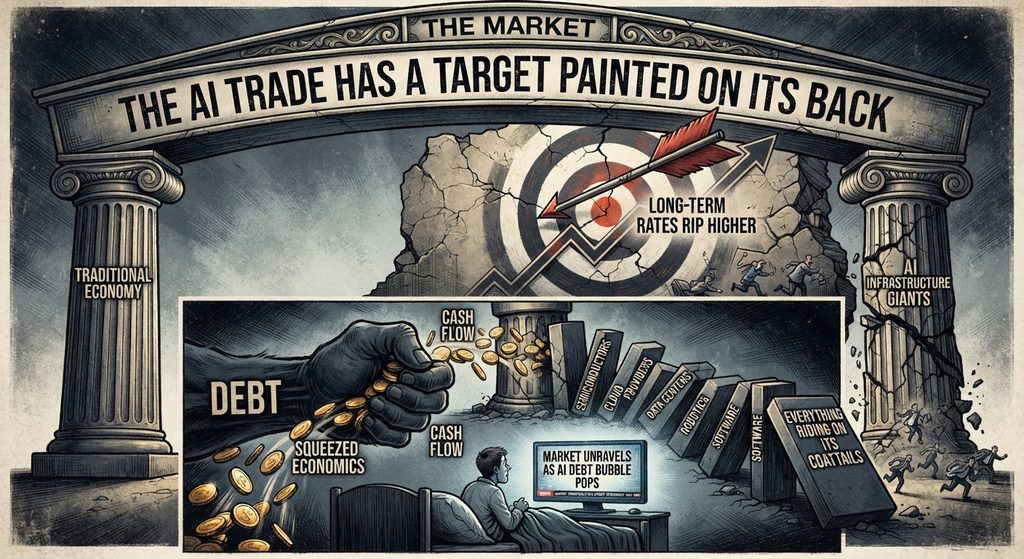
Here’s the part that should keep every investor up at night: the same companies driving the entire market higher — the AI infrastructure giants pouring hundreds of billions into data centers — are doing it increasingly on borrowed money. These are cash-rich companies drowning in debt they didn’t strictly need to take on, and as long-term rates rip higher, the cost of servicing that debt goes up in lockstep, squeezing the economics of the very buildout that’s been carrying the entire market on its back. If this trade cracks, it doesn’t just hurt tech investors — it drags down everything riding on its coattails.
JPMorgan’s breakdown of AI infrastructure financing structures
Chicago Booth Review, “How Worried Should We Be About AI Debt?“
he full breakdown of AI data-center debt exposure continues in Part 3 : The Bond Market’s Ultimatum, Part 1-3
This is not a one-week story. This is the new rules of the game.
What’s happening right now is bigger than a single Fed meeting, bigger than one Treasury announcement. Since 2008 — and especially since 2020 — central banks and governments have grabbed an ever-larger stranglehold on markets, and the old safety net investors used to count on has quietly disappeared: stocks and bonds no longer reliably move in opposite directions. They’ve fallen together in stress periods like 2018 and 2022, and there’s no guarantee that changes this time.
Alpha Architect, “Implications of Regime-Shifting Stock-Bond Correlation” (detailed 2022 figures)
Vanguard : Explainer on stock-bond correlation

The bond market has already sounded the alarm, loud and clear. The only question left is whether Washington listens — or whether investors are about to find out the hard way just how loud that alarm can get. Don’t overleverage. Don’t chase junk. Pay attention to what the bond market is screaming, because right now, it’s the only honest voice in the room.
Full external link list
Brookings Institution, “The Rise in Long-Term US Treasury Yields”: Brookings Institution
BlackRock Investment Institute weekly commentary: BlackRock
Charles Schwab, 2026 Taxable Fixed Income Mid-Year Outlook: Charles Schwab
Empower, “Between the Margins” (term premium analysis): Empower
BTRM (Bank Treasury Risk Management), commentary on the Warsh Fed’s trajectory: BTRM
Treasury Yields & Yield Curve
- 10-Year Treasury Yield: FRED (St. Louis Fed)
- 30-Year Treasury Yield: FRED (St. Louis Fed)
- Yield Curve Spread (Short vs. Long): FRED (St. Louis Fed)
U.S. Treasury Operations & Schedules
- Treasury Buyback Program Explainer: Fiscal Data Treasury
- Buyback Announcements & Results: TreasuryDirect
- Quarterly Refunding Schedule: U.S. Treasury
Monetary Policy & Economic Modeling
- Fed Policy Statements & FOMC Minutes: Federal Reserve
- Term Premium Model (NY Fed ACM Model): New York Fed
- U.S. National Debt & Deficit Statistics: Fiscal Data Treasury
Global Macroeconomic Context
- Japan’s Government Debt-to-GDP: IMF Fiscal Monitor
- UK Gilt Crisis (Truss) Background: Bank of England (Search on site for relevant policy archives)
Series: 2026 Bond Market Crisis