
Why “healthy” fruit can still work against you in large amounts
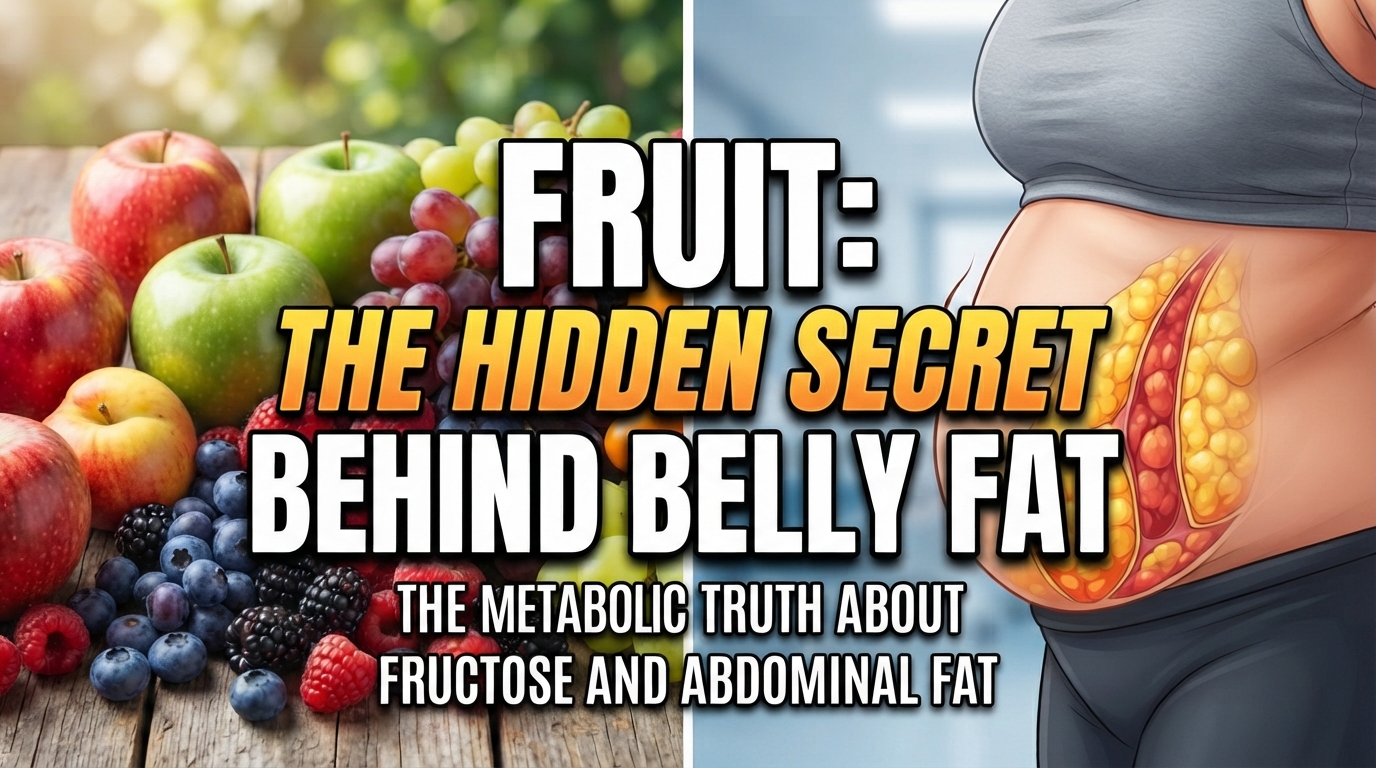
Fruit has a pretty spotless reputation. It’s whole food, it’s got fiber, vitamins, antioxidants — the opposite of junk food, right? Mostly, yes. But fruit’s natural sugar is still mostly fructose, and fructose behaves very differently in your body than the sugar in a slice of bread or a bowl of rice. In large enough quantities — especially in juice form — it can quietly build fructose-driven visceral fat — the kind that’s most dangerous for your metabolism: the fat around your organs.

The study that separated fructose from “just sugar”
For a long time, “sugar” got treated as one category. A landmark 10-week study out of UC Davis, led by researchers Kimber Stanhope and Peter Havel, tested whether that was true. Overweight adults drank either fructose-sweetened or glucose-sweetened beverages, both providing a quarter of their daily calories, for ten weeks straight.The study that separated fructose from “just sugar”

For a long time, “sugar” got treated as one category. A landmark 10-week study out of UC Davis, led by researchers Kimber Stanhope and Peter Havel, tested whether that was true. Overweight adults drank either fructose-sweetened or glucose-sweetened beverages, both providing a quarter of their daily calories, for ten weeks straight.
Both groups gained about the same amount of total body weight. If sugar were just sugar, that should have been the end of the story. It wasn’t. Only the fructose group packed on visceral fat from fructose — the fat around the abdominal organs. Only the fructose group saw their triglycerides climb, their insulin sensitivity drop, and their cholesterol markers worsen. The glucose group, drinking the same calories, showed none of it.
Same weight gain. Very different bodies underneath.
Both groups gained about the same amount of total body weight. If sugar were just sugar, that should have been the end of the story. It wasn’t. Only the fructose group packed on visceral fat from fructose — the fat around the abdominal organs. Only the fructose group saw their triglycerides climb, their insulin sensitivity drop, and their cholesterol markers worsen. The glucose group, drinking the same calories, showed none of it.
Same weight gain. Very different bodies underneath.
Fructose and Visceral Fat: Why This Combination Matters
Visceral fat isn’t just “belly fat” in the cosmetic sense — it wraps around your liver, intestines, and other organs, and it drains directly into a blood vessel (the portal vein) that runs straight to your liver. That means fat stored viscerally has a much more direct line of influence over liver function than fat stored elsewhere, like your hips or thighs. Even modest amounts of it can flood the liver with fatty acids and inflammatory signals, nudging the whole system toward insulin resistance.

Subcutaneous fat — the kind just under your skin — doesn’t behave this way nearly as aggressively. So where your body stores extra fat matters almost as much as how much you’re storing.
Why fructose ends up there
Here’s the mechanical difference. Glucose — from bread, rice, potatoes — gets used all over the body; muscles and the brain burn it directly, and insulin keeps the whole process tightly regulated.

Fructose takes a different route. It goes almost exclusively to the liver, skips several of the checkpoints that normally regulate how much sugar becomes fat, and comes out the other side as newly synthesized triglycerides — a process called de novo lipogenesis. Along the way, it also generates uric acid, which independently pushes the liver toward storing fat rather than burning it.
Robert Lustig, a pediatric endocrinologist at UCSF, has spent years popularizing a striking comparison: metabolically, this pathway has real overlaps with how the liver processes alcohol — both drive fat synthesis in the liver, both raise uric acid and triglycerides. It’s a useful way to picture the mechanism, though it’s worth being clear this is one researcher’s framing rather than settled consensus — other reviewers note that at more typical (non-extreme) intake levels, the gap between fructose and glucose’s effects on liver fat narrows.
Where whole fruit actually fits
This is the part that gets lost in translation. Whole fruit isn’t the villain here — fiber slows down how fast the sugar hits your system, and the fructose dose in, say, an apple or an orange is modest and comes bundled with water, fiber, and micronutrients that blunt its impact.

The concern is concentration and volume: fruit juice, dried fruit eaten in large quantities, and some modern ultra-sweet fruit cultivars deliver a much bigger fructose dose, much faster, with little to none of the fiber that would normally slow it down. A glass of orange juice can contain the fructose of several oranges with almost none of the fiber that came with them.
What this actually means for your plate

- Whole fruit, in normal portions, is fine for most people. You don’t need to fear an apple.
- Liquid fructose is the higher-leverage thing to cut. Soda, juice, and sweetened drinks deliver a fructose dose your liver can’t buffer the way it can with fiber-intact whole food.
- Watch your waistline, not just the scale. Visceral fat tracks with waist circumference far better than with total body weight — two people can weigh the same and carry very different metabolic risk.
- Total calories still count. Fructose isn’t magic — excess calories from any source can drive weight gain. What the research suggests is that fructose is unusually efficient at directing that extra energy specifically toward visceral fat.
- Dried fruit and juice deserve more caution than whole fruit, especially if you’re already carrying excess abdominal fat or dealing with early insulin resistance.
The bottom line

Fruit isn’t the problem — fructose in concentrated, fiber-stripped form is. The same sugar that’s mostly harmless in an orange becomes a much more efficient driver of visceral fat from fructose and liver stress once you strip out the fiber and drink it by the glass. If you’re trying to protect your metabolic health, the more useful question usually isn’t “is this fruit?” — it’s “is this whole, or is this liquid?”

This article synthesizes peer-reviewed research for general education. It is not personalized medical advice — talk to a qualified clinician about your own diet and risk factors.
Full external link list
Stanhope KL et al. Consuming Fructose-Sweetened, Not Glucose-Sweetened, Beverages Increases Visceral Adiposity and Lipids and Decreases Insulin Sensitivity in Overweight/Obese Humans. J Clin Invest, 2009. https://www.jci.org/articles/view/37385
Lustig RH. Fructose: It’s “Alcohol Without the Buzz.” Advances in Nutrition, 2013. https://advances.nutrition.org/article/S2161-8313(22)01107-3/fulltext
Chiu S et al. Fructose, high-fructose corn syrup, sucrose, and nonalcoholic fatty liver disease or indexes of liver health: a systematic review and meta-analysis. Am J Clin Nutr. https://ajcn.nutrition.org/article/S0002-9165(23)04749-4/fulltext