
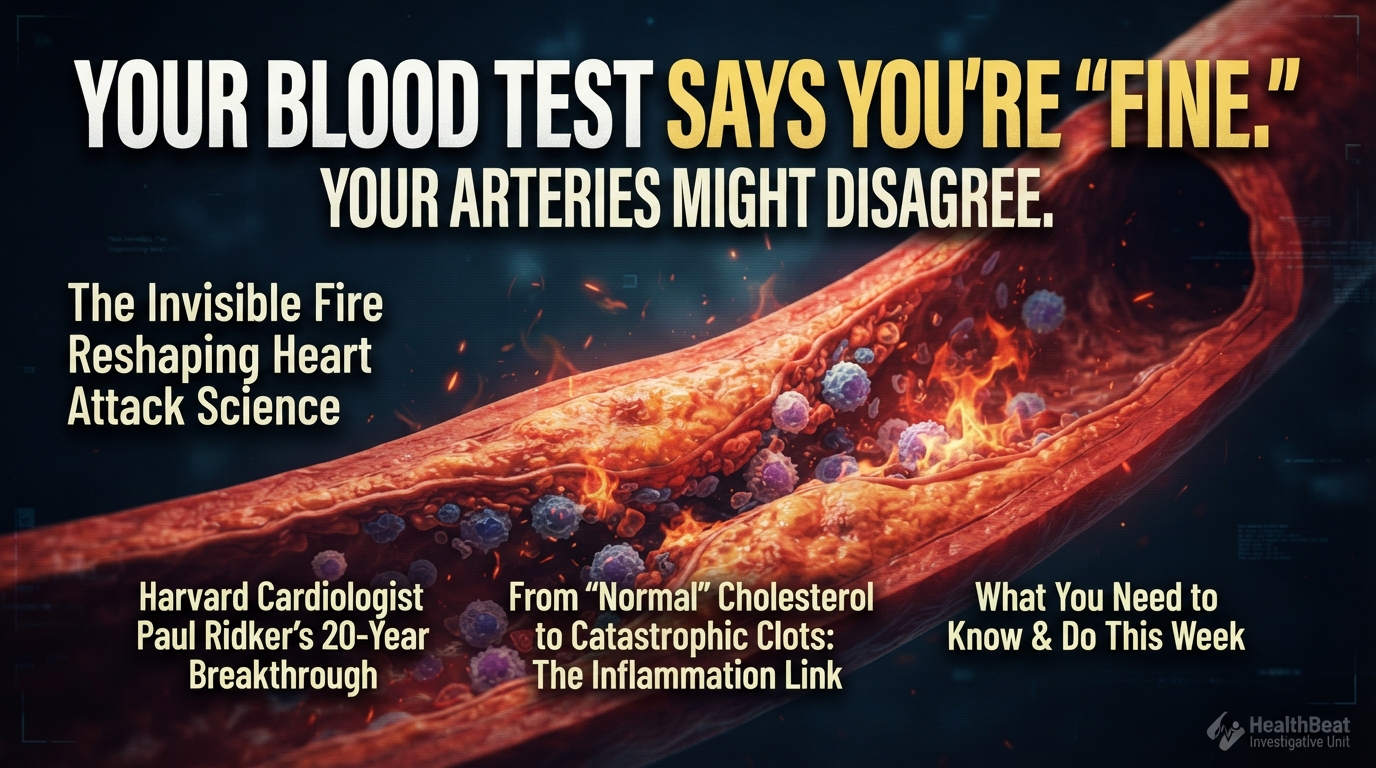
The invisible fire that’s rewriting what we thought we knew about heart attacks — and the $200,000-a-year drug that proved it, then flopped anyway
You ate the salad. You went for the walk. Your cholesterol panel came back “normal.” By every number your doctor checks at your annual physical, you’re doing everything right.
And yet heart attacks and strokes still blindside people who look, on paper, like the picture of health.
For two decades, a Harvard cardiologist named Paul Ridker has been building the case for why: your arteries might be smoldering with a low-grade inflammatory fire that never shows up as a symptom — until it does, catastrophically, as a clot.
This isn’t fringe wellness content. It’s mainstream cardiology, tested in massive randomized trials, and it’s already changed which drugs get prescribed in North America. Here’s what’s actually been proven, what hasn’t, and what you can do about it starting this week.
The trial that stopped early because the results were too good
In 2008, Ridker and his team ran something called the JUPITER trial. They recruited over 17,000 people who had unremarkable cholesterol — nothing that would normally trigger a statin prescription — but elevated levels of a blood marker called high-sensitivity C-reactive protein, or hsCRP. Think of hsCRP as a smoke detector for inflammation: it doesn’t tell you where the fire is, just that something in the body is inflamed.
Link “JUPITER trial” → https://www.nejm.org/doi/full/10.1056/NEJMoa0807646 (Ridker PM et al., NEJM, 2008 — the original trial publication)

Half the group got a statin (rosuvastatin, brand name Crestor). Half got a placebo.
The results were dramatic enough that the independent safety board pulled the plug on the trial early, before it was even supposed to finish — continuing would have meant denying a clearly beneficial drug to the placebo group. Heart attacks dropped by roughly half, strokes by close to that, and overall cardiovascular events fell by 44%.
The twist: these people had “good” cholesterol. The benefit couldn’t be explained by LDL-lowering alone. Something else was going on — and the leading theory was that statins were quieting inflammation, not just clearing cholesterol.
Then came the drug that proved the theory — and failed anyway
If JUPITER was circumstantial evidence, the CANTOS trial was the smoking gun. Ridker’s team wanted a drug that did only one thing: block inflammation, with zero effect on cholesterol. They landed on canakinumab, a biologic that neutralizes a specific inflammatory signal called interleukin-1β.
Link “CANTOS trial” → https://www.nejm.org/doi/full/10.1056/NEJMoa1707914 (Ridker PM et al., NEJM, 2017)

They gave it to over 10,000 heart attack survivors who still had elevated hsCRP despite being on standard therapy. The result: a roughly 15% reduction in second heart attacks, strokes, and cardiovascular death — with essentially no change in cholesterol. This was the cleanest proof yet that inflammation itself, independent of cholesterol, drives heart disease.
Cardiology took notice. Pharma did not.
Canakinumab costs somewhere in the neighborhood of $200,000 a year in the US. The patients in the trial were already stable on statins that cost pennies a day. When health economists ran the numbers, the price tag made canakinumab a non-starter for this use — one widely cited analysis found it wasn’t cost-effective even at a fraction of its list price. Brilliant science, hopeless economics. The drug never got approved for heart disease and quietly faded from that conversation.
Link → https://jamanetwork.com/journals/jamacardiology/fullarticle/2720424 (Sehested et al., JAMA Cardiology, 2019 — found canakinumab’s price would need to drop more than 98% to be cost-effective in the US)
Since you and your readers are Canada-based, there’s also a Canadian-specific version of this same analysis, which may resonate more: https://pubmed.ncbi.nlm.nih.gov/35607490/ (University of Ottawa Heart Institute, found a 0% probability canakinumab was cost-effective at Canadian willingness-to-pay thresholds)
The plot twist: a decades-old gout pill finished the job
Here’s the part that should annoy every biotech investor and delight every patient: the drug that actually made it to market for this purpose isn’t a biologic at all. It’s colchicine — a cheap, generic anti-inflammatory that’s been used to treat gout since before statins existed.

Two major trials, COLCOT and LoDoCo2, tested a low 0.5 mg daily dose of colchicine on top of standard heart disease treatment. The results: roughly 23–31% reductions in major cardiovascular events. In June 2023, the FDA approved low-dose colchicine (brand name Lodoco) as the first anti-inflammatory drug specifically indicated to reduce cardiovascular risk — available to anyone with established heart disease or multiple risk factors, for a fraction of what canakinumab would have cost.
Sometimes the unglamorous option wins.
Link “COLCOT” → https://pubmed.ncbi.nlm.nih.gov/31733140/ (Tardif et al., NEJM, 2019) Link “LoDoCo2” → https://www.nejm.org/doi/10.1056/NEJMoa2021372 (Nidorf et al., NEJM, 2020) Link “FDA approved low-dose colchicine (brand name Lodoco)” → https://www.dicardiology.com/content/us-fda-approves-first-anti-inflammatory-drug-cardiovascular-disease (confirms the 31% risk reduction figure you cite, and the June 2023 approval date)
What “silent inflammation” actually looks like on your labs
You don’t need exotic testing to catch this. In routine North American primary care, a few unremarkable-looking numbers are the tell:

- hsCRP persistently at or above 2 mg/L — the exact threshold used in JUPITER and CANTOS
- HbA1c creeping up, even while still technically “prediabetic”
- Waist circumference — visceral fat is metabolically active tissue that pumps out inflammatory signals, and it’s a cheap, low-tech proxy that correlates strongly with risk
- Blood pressure drifting upward, even before it crosses into a formal hypertension diagnosis
None of these will trigger an ER visit. That’s exactly the problem — they’re a decade-long slow burn, not a five-alarm fire, and North American diets and sedentary routines are very good at keeping that burn going.
So what should you actually do with this?
The honest answer is that drugs are part of the story, not the whole story. Statins, low-dose colchicine in the right patients, and — worth noting — the new generation of GLP-1 drugs (Ozempic, Wegovy, Mounjaro) also appear to lower inflammatory markers as a side effect of the weight and metabolic improvements they drive. But no pill outruns a lifestyle that keeps refueling the fire.

The higher-leverage, less glamorous levers are still where most of the benefit lives:
- Lose visceral fat — even a modest reduction measurably drops hsCRP
- Move daily — regular activity is one of the most reliable ways to lower inflammatory markers
- Sleep enough — poor sleep is itself a driver of systemic inflammation
- Cut back on ultra-processed food — the immune system reacts to what you eat more than most people realize
- Manage stress and blood pressure — both feed the same inflammatory pathway
Chronic inflammation isn’t a diagnosis you’re stuck with. It’s a signal — one your doctor can measure with a cheap blood test — that your immune system has been running on high alert for too long. The fix starts with knowing the number exists: ask about hsCRP at your next physical, get your waist measured, and have an honest conversation about whether your risk profile calls for more than the standard cholesterol conversation.
The fire is quiet. That doesn’t mean it isn’t there.
This article is for informational purposes only and isn’t medical advice. Talk to your doctor before starting or stopping any medication, including statins or colchicine.
Full external link list
Ridker PM et al. Rosuvastatin to Prevent Vascular Events in Men and Women with Elevated C-Reactive Protein (JUPITER). NEJM, 2008. https://www.nejm.org/doi/full/10.1056/NEJMoa0807646
Ridker PM et al. Antiinflammatory Therapy with Canakinumab for Atherosclerotic Disease (CANTOS). NEJM, 2017. https://www.nejm.org/doi/full/10.1056/NEJMoa1707914
Tardif JC et al. Efficacy and Safety of Low-Dose Colchicine after Myocardial Infarction (COLCOT). NEJM, 2019. https://pubmed.ncbi.nlm.nih.gov/31733140/
Nidorf SM et al. Colchicine in Patients with Chronic Coronary Disease (LoDoCo2). NEJM, 2020. https://www.nejm.org/doi/10.1056/NEJMoa2021372
FDA approval announcement, Lodoco (colchicine), June 2023. https://www.dicardiology.com/content/us-fda-approves-first-anti-inflammatory-drug-cardiovascular-disease
Sehested TSG et al. Cost-effectiveness of Canakinumab for Prevention of Recurrent Cardiovascular Events. JAMA Cardiology, 2019. https://jamanetwork.com/journals/jamacardiology/fullarticle/2720424
Canadian cost-effectiveness analysis of canakinumab, University of Ottawa Heart Institute. https://pubmed.ncbi.nlm.nih.gov/35607490/