
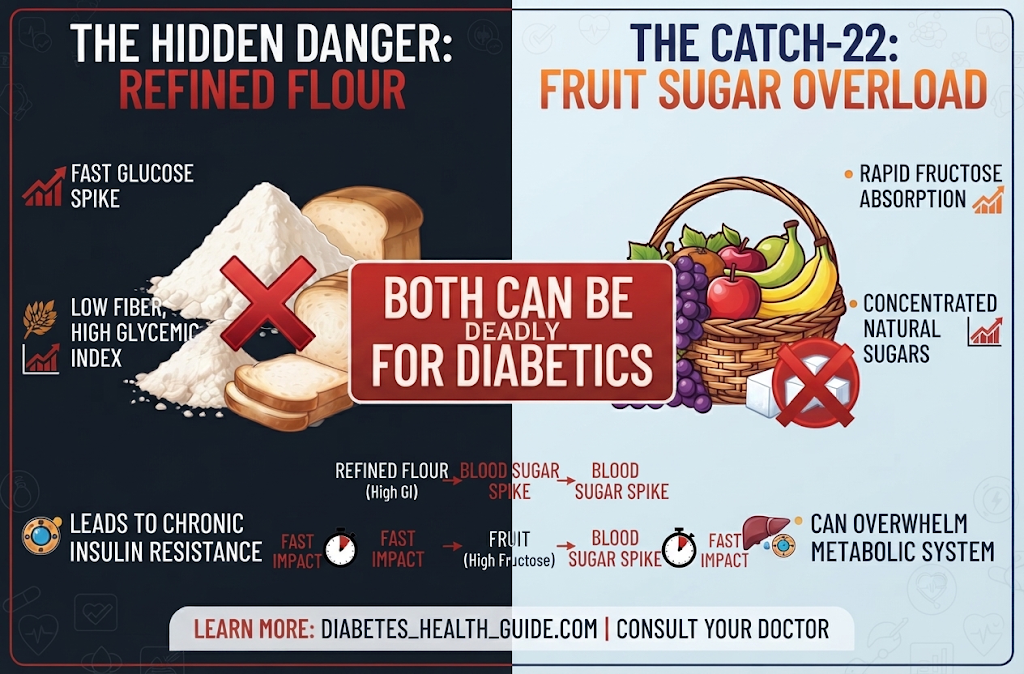
Why the “blood sugar spike” panic might be pointing you at the wrong culprit
For a decade, the wellness internet has been obsessed with one number: how high your blood sugar jumps after you eat. Continuous glucose monitors, “glucose goddess” hack s, avoiding bananas because they spike a graph — the whole culture treats every carbohydrate as roughly equally dangerous, and treats the spike itself as the enemy.

But if you look at where type 2 diabetes actually comes from — not the symptom, the mechanism — the picture is more specific, and honestly more useful. It points less at bread and rice, and more at insulin resistance and visceral fat and more at your liver, your belly fat, and one particular sugar: fructose.
Diabetes isn’t really an insulin problem. It’s a fat problem.
Fixing Insulin Resistance and Visceral Fat: What Actually Moves the Needle
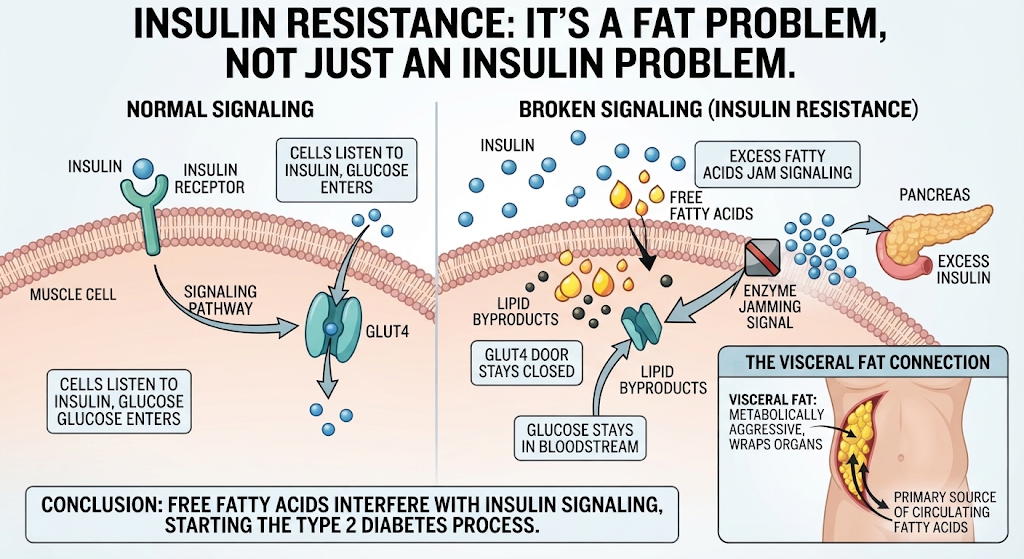
Type 2 diabetes gets described as “not enough insulin,” but that’s backwards for most people who develop it. Early on, they usually have plenty of insulin — their cells just stop listening to it. That’s insulin resistance, and it’s the real starting point.
Here’s the mechanism: insulin’s job is to tell muscle and fat cells to open the door for glucose — literally moving a transporter protein (GLUT4) to the cell surface. When that signal breaks down, glucose stays stuck in the bloodstream, and the pancreas compensates by pumping out more and more insulin, for years, before things fall apart.
So what breaks the signal? Research out of Yale, led by Gerald Shulman, traced it to fat — specifically, free fatty acids circulating in the blood and their byproducts inside muscle and liver cells. These molecules activate an enzyme that jams insulin’s signaling pathway before it can move any glucose at all. Researchers have confirmed this directly: raise fatty acid levels in a healthy person’s blood, and you can induce insulin resistance and visceral fat in their muscles within hours — no genetics, no years of bad diet required, just the fat itself.
Not all body fat behaves the same way here. The fat wrapped around your organs — visceral fat — is far more metabolically aggressive than the fat under your skin. It releases fatty acids more readily, dumps them straight into circulation, and appears to be the primary fuel for this whole process.
The sugar that becomes fat almost immediately: fructose
This is where the fruit-vs-flour question gets interesting.
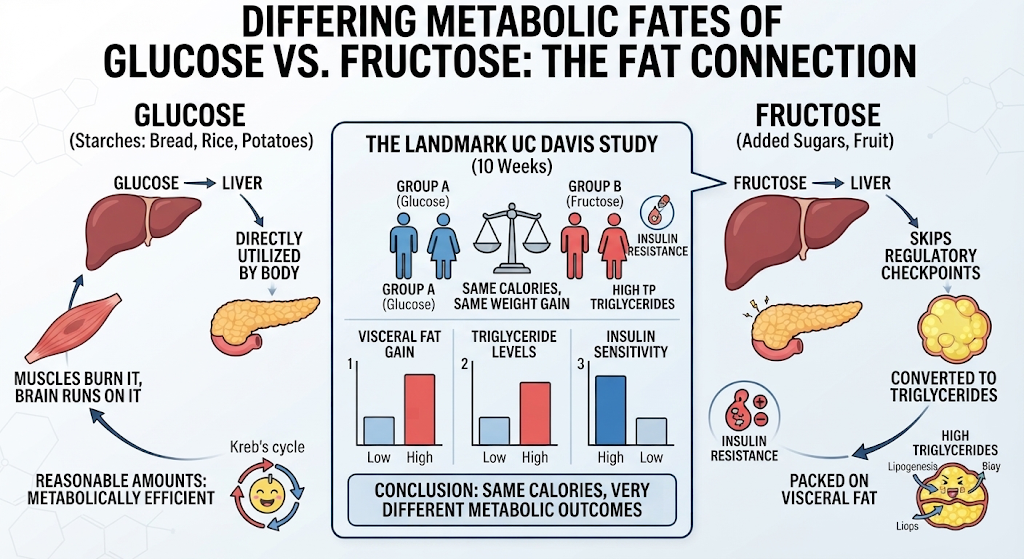
Starches — bread, rice, potatoes, pasta — break down mostly into glucose. Your body is very good at using glucose directly: muscles burn it, the brain runs on it, and in reasonable amounts it doesn’t require much metabolic gymnastics.
Fructose is handled completely differently. It goes almost straight to the liver, skips the regulatory checkpoints that normally control how much of a sugar gets converted into fat, and comes out the other side as triglycerides. In a landmark 10-week controlled study at UC Davis, researchers had overweight adults drink beverages sweetened with either fructose or glucose, matched for calories. Both groups gained the same amount of weight. But only the fructose group packed on visceral fat, developed higher triglycerides, and became measurably less insulin-sensitive. Same calories, same weight gain, different sugar, very different metabolic outcome.
Robert Lustig at UCSF has spent years making the case — controversially, but with real data behind it — that concentrated fructose sources (soda, fruit juice, and the high-fructose corn syrup buried in processed food) drive liver fat and insulin resistance more efficiently than almost anything else in a typical diet. Whole fruit is a different story: the fiber slows absorption and the sugar load per bite is much lower. It’s really the concentrated, liquid fructose — the stuff with no fiber attached — that seems to matter most.
So should you stop worrying about blood sugar spikes?
Not entirely — this is the part worth being careful about. If you already have diabetes or prediabetes, keeping post-meal glucose in check still matters for protecting your eyes, kidneys, and blood vessels long-term. That part of the “watch your spikes” advice isn’t wrong.
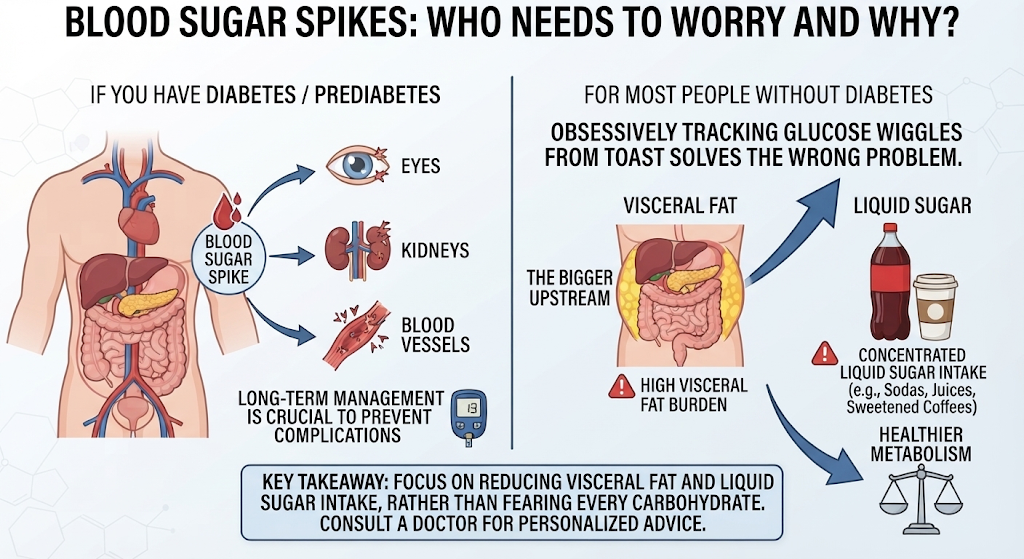
What this research does suggest is that for most people who don’t yet have diabetes, obsessively tracking every glucose wiggle from a piece of toast is probably solving the wrong problem. The bigger lever is upstream: how much visceral fat you’re carrying, and how much of your sugar intake is coming in liquid, concentrated form.
What actually seems to move the needle
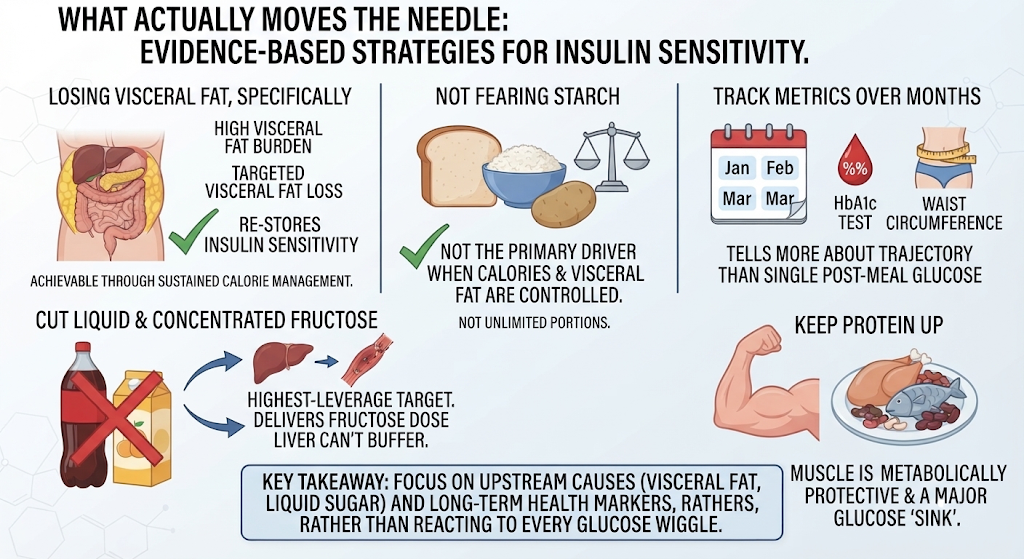
- Losing visceral fat, specifically. Not just “losing weight” — intra-abdominal fat loss is what tends to restore insulin sensitivity, and it’s achievable through sustained calorie management even before dramatic weight loss shows up on a scale.
- Cutting liquid and concentrated fructose first. Soda, juice, and sugar-sweetened drinks are the highest-leverage target — they deliver a fructose dose your liver can’t buffer the way it can with whole food.
- Not fearing starch itself. Bread, rice, and potatoes aren’t the primary driver here when your overall calorie balance and visceral fat are under control. This doesn’t mean unlimited portions — it means they’re not the villain the spike-obsessed narrative makes them out to be.
- Tracking the metrics that matter over months, not minutes. HbA1c and waist circumference tell you more about your actual trajectory than any single post-meal glucose reading.
- Keeping protein up. Muscle mass is metabolically protective — it’s one of the biggest glucose “sinks” your body has.
The bottom line
The strongest mechanistic evidence for how most adult-onset type 2 diabetes actually develops points to visceral fat and the fatty acids it releases — not the glucose itself, and not the size of any single blood sugar spike. And of the common dietary sugars, fructose — especially in soda and juice, not whole fruit — appears to be an unusually efficient driver of exactly that kind of fat.
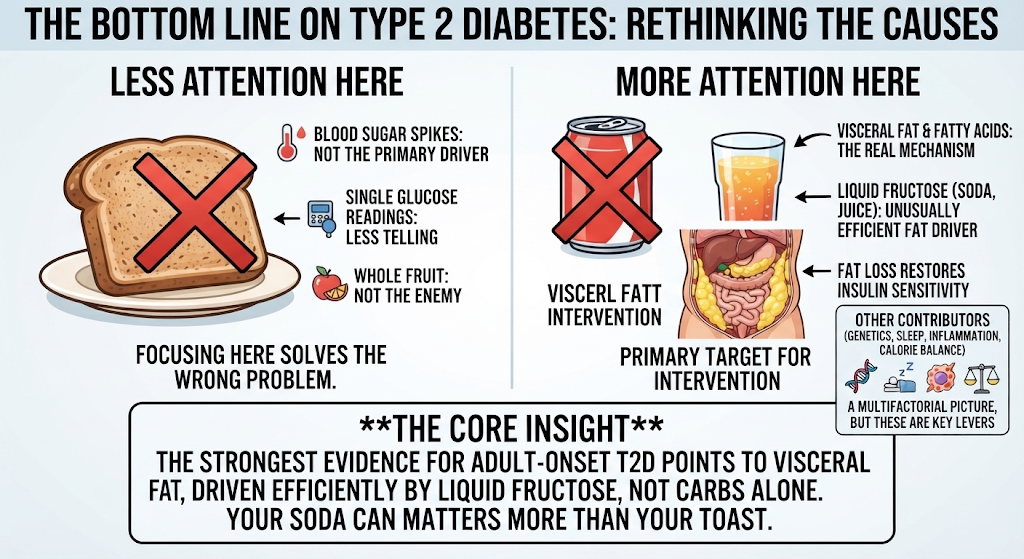
It’s worth saying plainly: this isn’t the only model in diabetes research, and insulin resistance and visceral fat is genuinely multifactorial — genetics, inflammation, sleep, and total calorie balance all play a role too. But if you’re choosing where to spend your attention, the evidence points less at your toast and more at your soda can.
This article is a synthesis of peer-reviewed research for general education. It is not personalized medical advice — talk to a qualified clinician about your own risk factors and diet.
Full external link list
Roden M, Shulman GI et al. Mechanism of Free Fatty Acid-Induced Insulin Resistance in Humans. J Clin Invest, 1996. https://www.jci.org/articles/view/118742
Shulman GI. Lipid-induced insulin resistance: unravelling the mechanism. The Lancet, 2010. https://www.thelancet.com/journals/lancet/article/PIIS0140673610604084/abstract
Stanhope KL et al. Consuming Fructose-Sweetened, Not Glucose-Sweetened, Beverages Increases Visceral Adiposity… J Clin Invest, 2009. https://www.jci.org/articles/view/37385
Lustig RH. Fructose: It’s “Alcohol Without the Buzz.” Advances in Nutrition, 2013. https://advances.nutrition.org/article/S2161-8313(22)01107-3/fulltext