
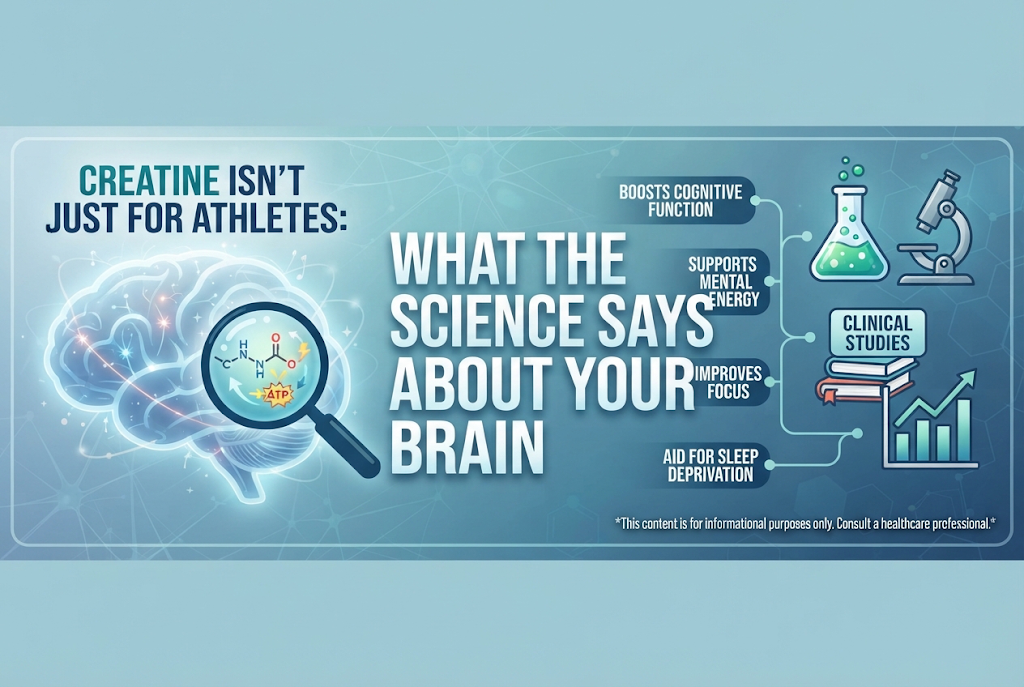
What the Science Says About Your Brain.
For decades, creatine had one reputation: a gym-bag staple for lifters chasing bigger muscles and faster recovery. That reputation is still well-earned — it remains one of the most extensively studied and safest supplements in sports nutrition. But over the past two decades, a quieter body of research has been building around a very different question: what does creatine do for the brain?
The short answer is more than most people realize. Your brain is metabolically expensive tissue — it makes up about 2% of body weight but burns roughly 20% of your daily energy. And just like your muscles, your neurons rely on a fast-acting energy buffer called the phosphocreatine system to keep up with demand. That single mechanical fact is the thread connecting everything that follows.
The Energy Currency Your Brain Runs On
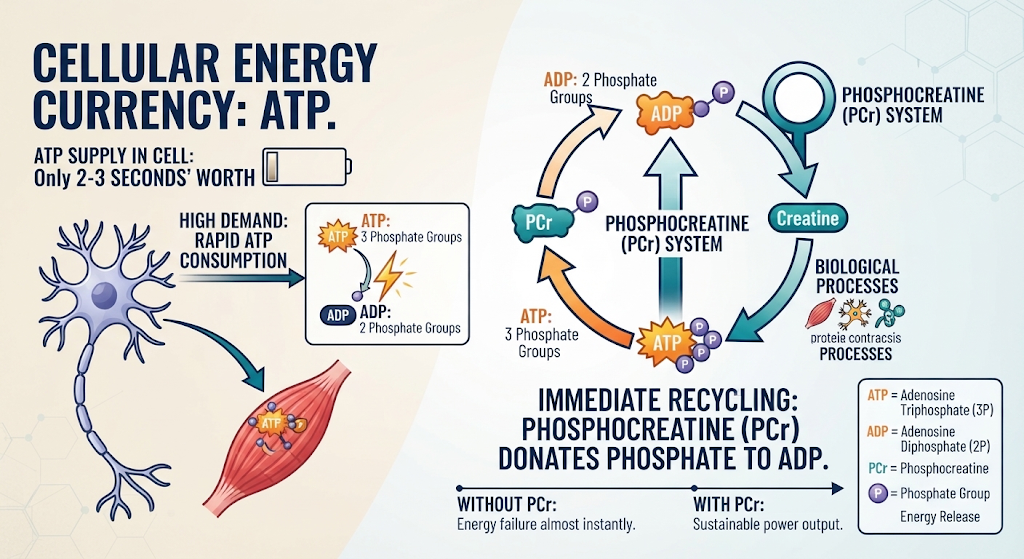
Every cell in your body — muscle fiber or neuron — runs on adenosine triphosphate (ATP), the molecule that powers virtually every biological process. The problem is that cells only keep a few seconds’ worth of ATP on hand at any given time. To avoid running out during moments of high demand, cells rely on a rapid-recycling system: phosphocreatine donates a phosphate group to spent ADP, regenerating it back into usable ATP almost instantly.
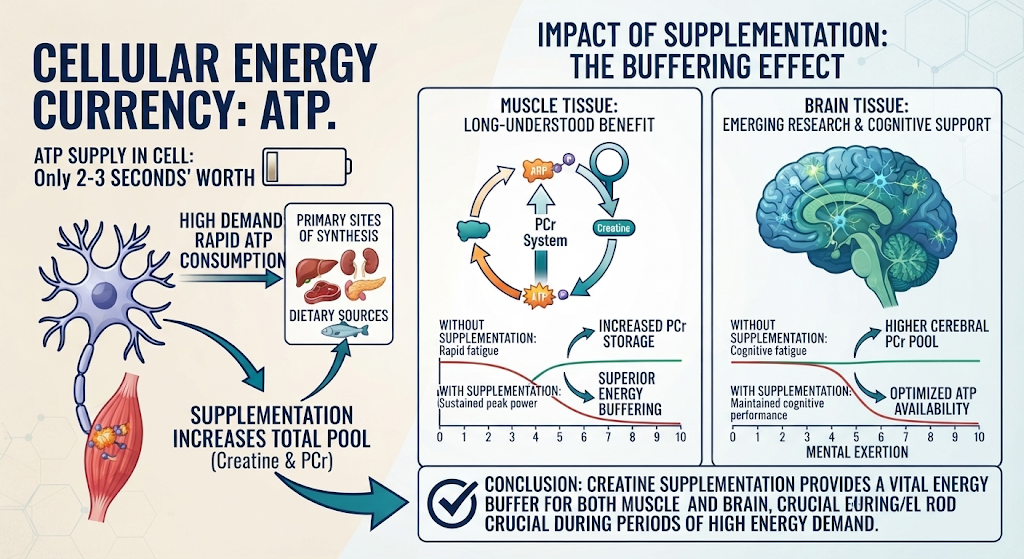
Creatine is the raw material for that system. Your body makes some on its own (mostly in the liver, kidneys, and pancreas) and gets the rest from dietary sources like meat and fish. Supplementing with creatine monohydrate increases the total pool of creatine and phosphocreatine available for this recycling process — and while that’s long been understood for muscle tissue, researchers have increasingly turned their attention to whether the same buffering effect matters for the brain, an organ with energy demands that rival or exceed skeletal muscle during exertion.
The Study That Started the Conversation: Rae et al., 2003
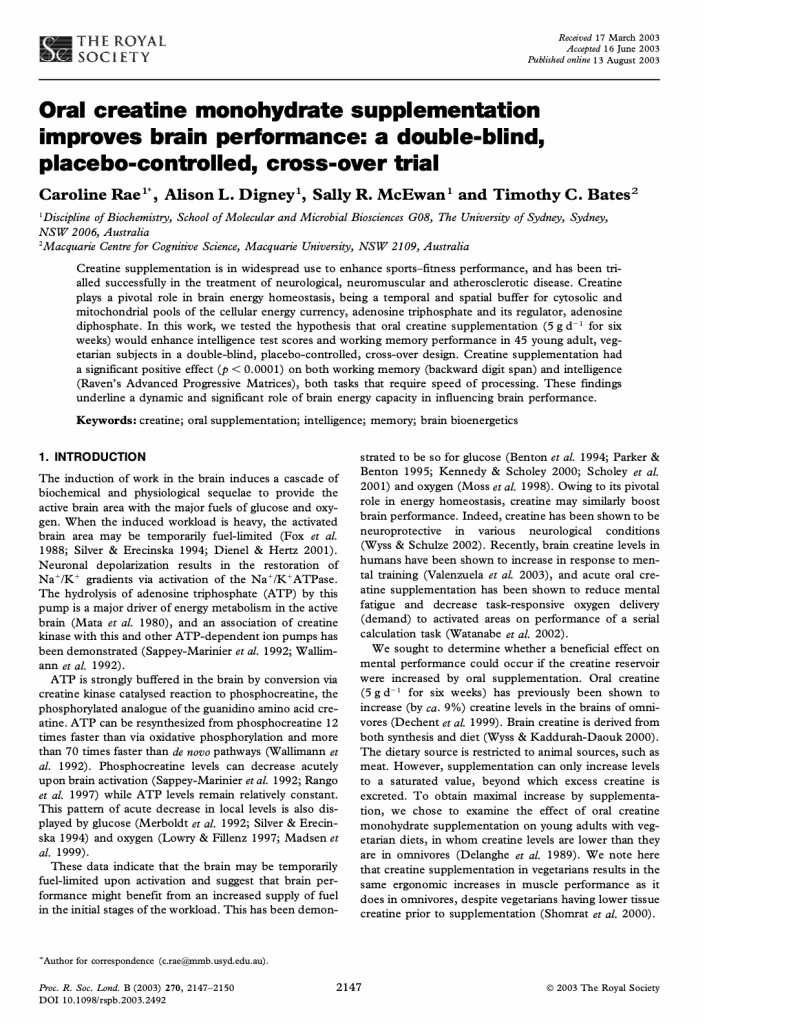
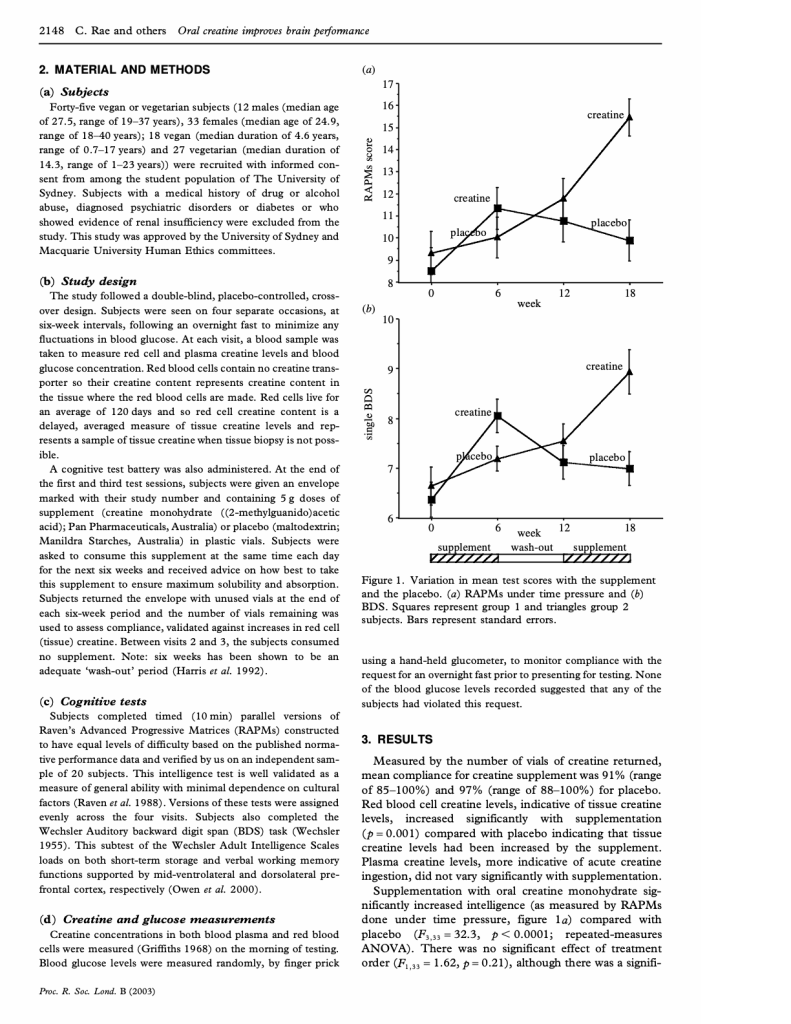
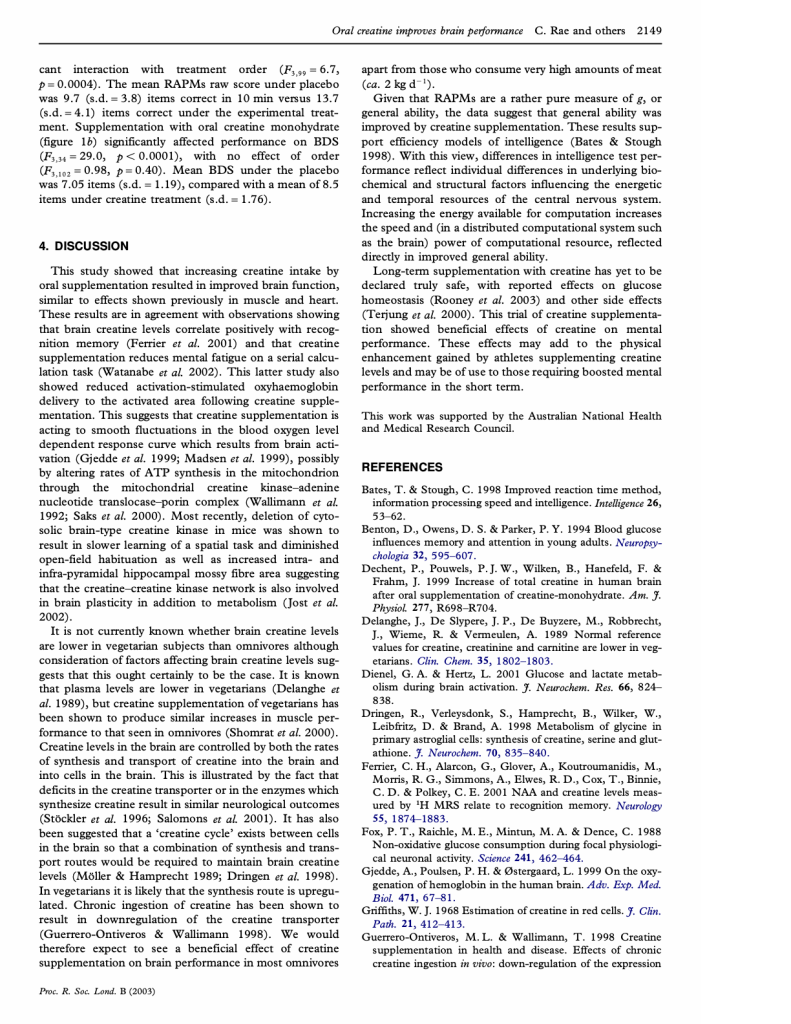
The pivotal early study came from a research group led by Caroline Rae at the University of Sydney, published in Proceedings of the Royal Society B in 2003. The researchers gave 45 young vegetarian adults either 5 grams of creatine per day or a placebo for six weeks, then tested working memory (using the Backward Digit Span task) and fluid intelligence (using Raven’s Advanced Progressive Matrices).
The results were striking for a nutrition study: significant improvements in both measures among the group taking creatine. Vegetarians were chosen deliberately — since dietary creatine comes almost exclusively from animal products, vegetarians tend to start with lower baseline creatine stores, which made them a more sensitive population for detecting a supplementation effect. The logic was straightforward: if creatine matters for cognition, people who have less of it to begin with should show the biggest response when given more.
That single study didn’t settle the question, but it opened the door to two decades of follow-up research trying to answer it more rigorously.
Sleep Deprivation: Where the Effect Shows Up Most Clearly
If creatine’s cognitive benefits are hard to detect in well-rested, healthy adults, they become much easier to see under metabolic stress — and sleep deprivation turns out to be one of the clearest testing grounds.
A 2024 study led by Ali Gordji-Nejad at the Institute of Neuroscience and Medicine in Jülich, Germany, put this to the test directly. Researchers gave participants a single high dose of creatine monohydrate (0.35 g per kilogram of body weight — roughly 24 grams for a 70 kg person) or a placebo, then kept them awake for 21 hours while running cognitive tests and brain imaging scans. Using phosphorus magnetic resonance spectroscopy, they could directly observe brain phosphocreatine and ATP levels in real time.
The results: participants who received creatine maintained more stable brain energy levels during sleep deprivation, and performed measurably better on cognitive tasks compared to the placebo group. The researchers’ interpretation is worth sitting with — under normal conditions, the blood-brain barrier limits how much supplemental creatine actually reaches brain tissue, since neurons largely synthesize their own supply. But under metabolic stress, that barrier appears to become more permeable to creatine uptake, allowing supplementation to matter more than it would on an ordinary, well-rested day.


A Newer Frontier: Creatine and Neurodegenerative Disease
It’s worth noting the study’s own caution here: the lead researcher explicitly flagged that a dose this high isn’t something people should replicate casually at home, since large single doses put meaningful strain on the kidneys. The research finding is about mechanism and possibility, not a home dosing protocol.
The most recent thread in this research moved from healthy adults to a much more vulnerable population. A 2025 pilot study led by A.N. Smith and colleagues, published in Alzheimer’s & Dementia: Translational Research & Clinical Interventions, gave 20 patients with Alzheimer’s disease (average age 73) 20 grams of creatine monohydrate daily for eight weeks.
The findings were genuinely encouraging for a first-of-its-kind trial: brain total creatine levels, measured by MRI spectroscopy, increased in 85% of participants, with an average rise of about 11%. More notably, the study also observed measurable improvements on cognitive testing — including global cognition scores and specific tests of processing and executive function — with no adverse events reported.
The researchers themselves are careful to frame this as a small, single-arm feasibility study rather than proof of a treatment effect. But it’s the first human trial to test high-dose creatine specifically in Alzheimer’s patients, and it lays the groundwork for the larger, placebo-controlled trials that would be needed to know whether the cognitive gains are real and reproducible.


So How Much Creatine Do You Actually Need?
This is where the research gets genuinely unsettled, and it’s worth being honest about that rather than pretending there’s a clean answer.
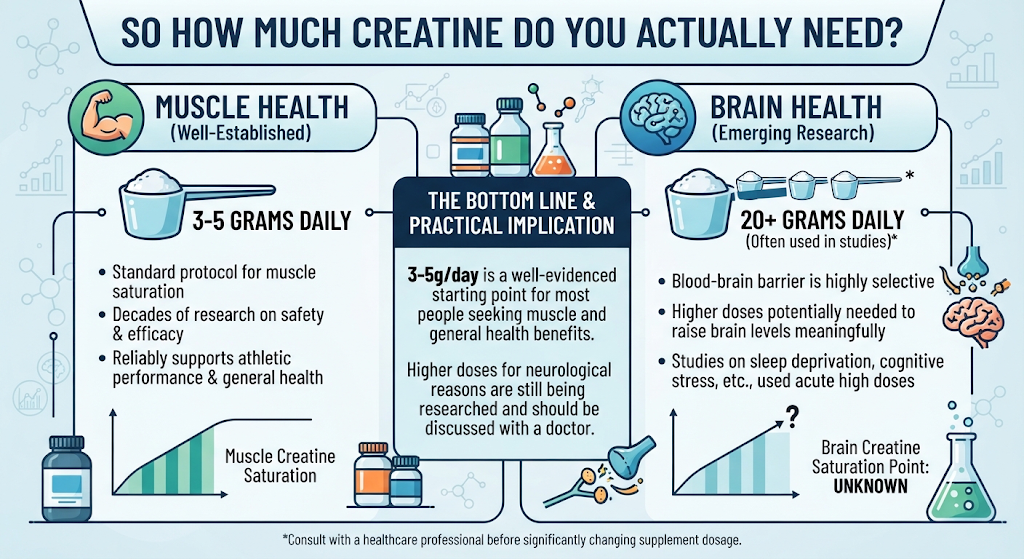
The dose long established as safe and effective for muscle — roughly 3 to 5 grams per day — comes from decades of sports nutrition research. Whether that same dose is enough to meaningfully raise brain creatine levels is a separate, much newer question. The blood-brain barrier is far more selective than the blood-muscle barrier, and several of the more striking brain-related findings — the Jülich sleep deprivation study, the Alzheimer’s pilot — used considerably higher doses (20+ grams per day, or a single large dose calibrated to body weight) than the standard muscle-building protocol.
Researchers reviewing this field have pointed out that we still don’t have solid dose-response data specifically for brain creatine saturation — that is, nobody has cleanly established whether 5g, 10g, or 20g per day produces meaningfully different increases in brain creatine, or where the point of diminishing returns actually sits. What is reasonably well supported is the general pattern: standard doses (3-5g/day) reliably support muscle creatine stores and general health, while the studies specifically designed to detect brain effects have tended to use higher doses or acute high-dose protocols, particularly when testing performance under cognitive or physical stress.

The practical implication for most people: 3-5 grams a day remains a well-tolerated, well-evidenced starting point for general health and the muscular benefits creatine is best known for. Anyone considering higher doses specifically for cognitive or neurological reasons — especially in the context of a medical condition — is in a research area that’s still actively being mapped out, and that conversation is worth having with a doctor rather than deciding from a supplement label alone.
The Bottom Line
Creatine’s story has quietly expanded well past the gym. The same energy-buffering mechanism that helps a muscle fiber fire during a heavy set appears to help a sleep-deprived brain stay sharp, and early clinical work suggests it may even support brain energy metabolism in neurodegenerative disease. None of this displaces creatine’s core, well-established role in strength and exercise performance — if anything, it adds a second reason to take the supplement seriously as one of the few in the category with genuine mechanistic plausibility and a strong safety record behind it.
The research is still young in the brain-health space specifically, and dosing questions remain open. But for a supplement that’s inexpensive, extensively studied for safety, and now showing up across sleep science, cognitive performance research, and neurodegenerative disease trials, creatine has earned a second look — this time, for what it might be doing above the neck.
References: Rae, C. et al. (2003), Proceedings of the Royal Society B, 270(1529), 2147-2150. Gordji-Nejad, A. et al. (2024), Scientific Reports, 14, 4937. Smith, A.N. et al. (2025), Alzheimer’s & Dementia: Translational Research & Clinical Interventions, 11(2), e70101.