
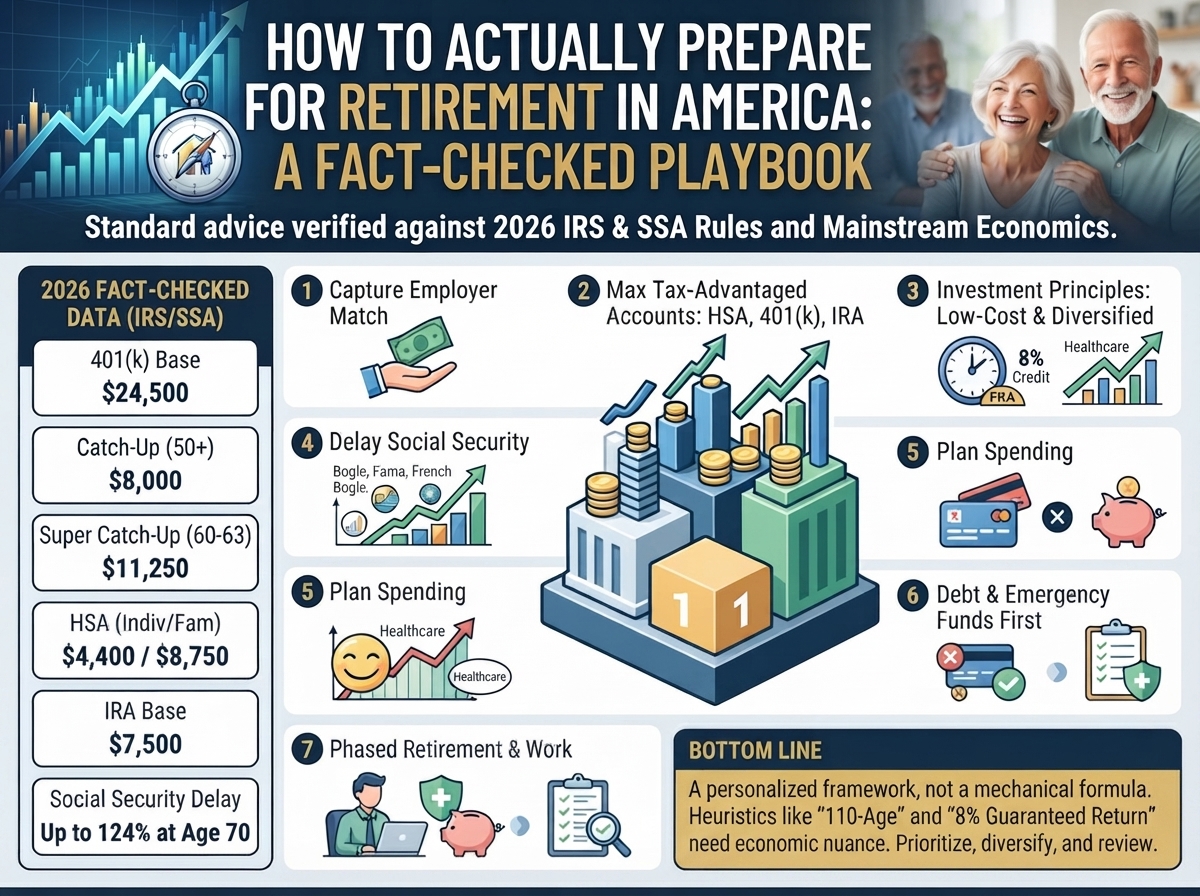
A Fact-Checked Playbook
The standard practical advice for U.S. retirement savers, checked against IRS and SSA rules, and read through the lens of mainstream retirement economics.
How do you actually prepare for retirement in America? Most of the popular playbook for U.S. retirement savers — max the match, stack tax-advantaged accounts, delay Social Security — is well-grounded in the actual rules and in the academic literature on savings behavior. A few pieces of common advice, however, are oversimplified in ways that a professional financial economist would flag. Below is the playbook, verified against 2026 IRS and SSA figures, with those nuances added back in.
1. Capture the Employer Match — Confirmed, No Caveat Needed
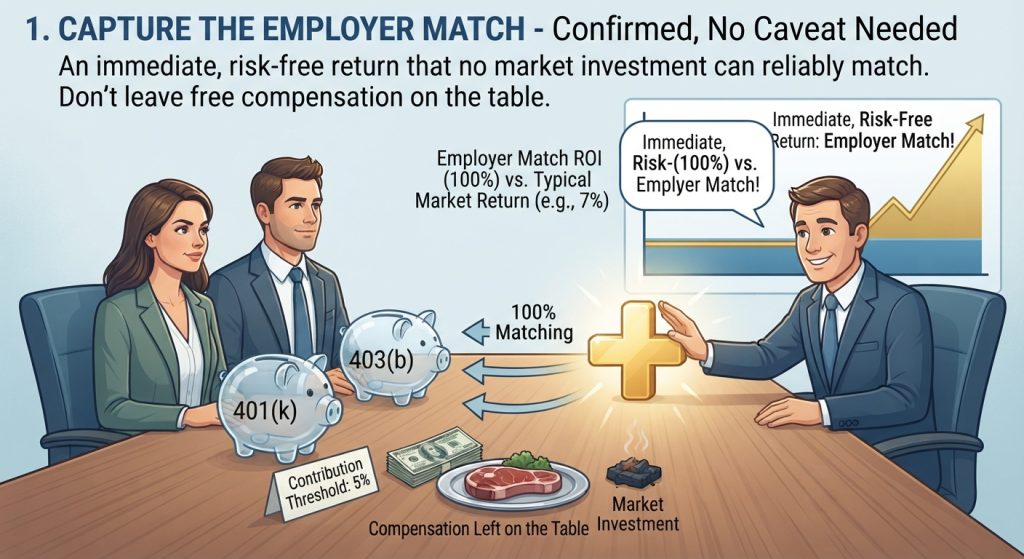
This is the one piece of advice with essentially no economist dissent: an employer 401(k)/403(b) match is an immediate, risk-free return that no market investment can reliably match. Failing to contribute up to the match threshold is, in the literal sense, leaving compensation on the table.
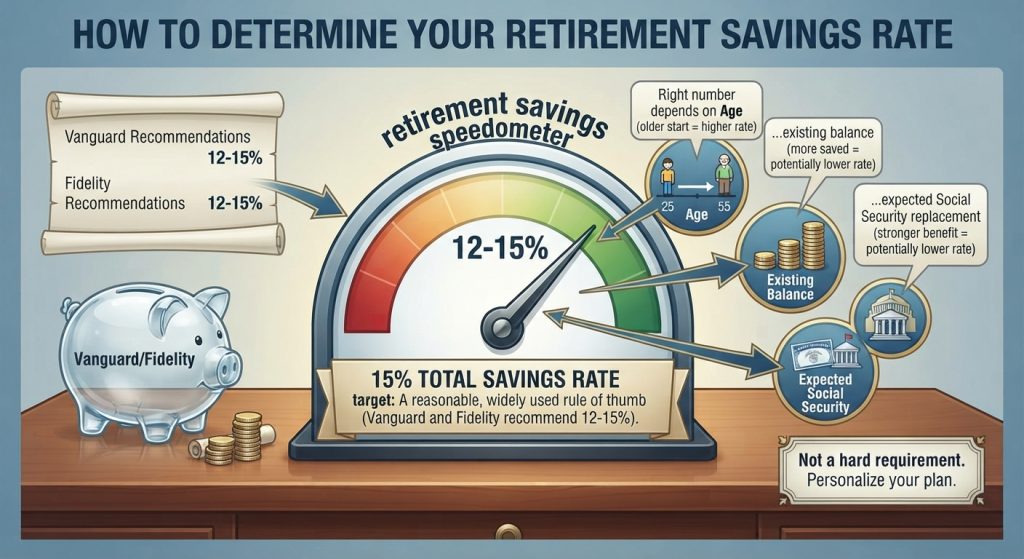
On the “15% total savings rate” target: this is a reasonable, widely used rule of thumb (Vanguard and Fidelity both recommend a similar 12–15% combined employee-plus-employer range), not a hard requirement — the right number depends on age, existing balance, and expected Social Security replacement.

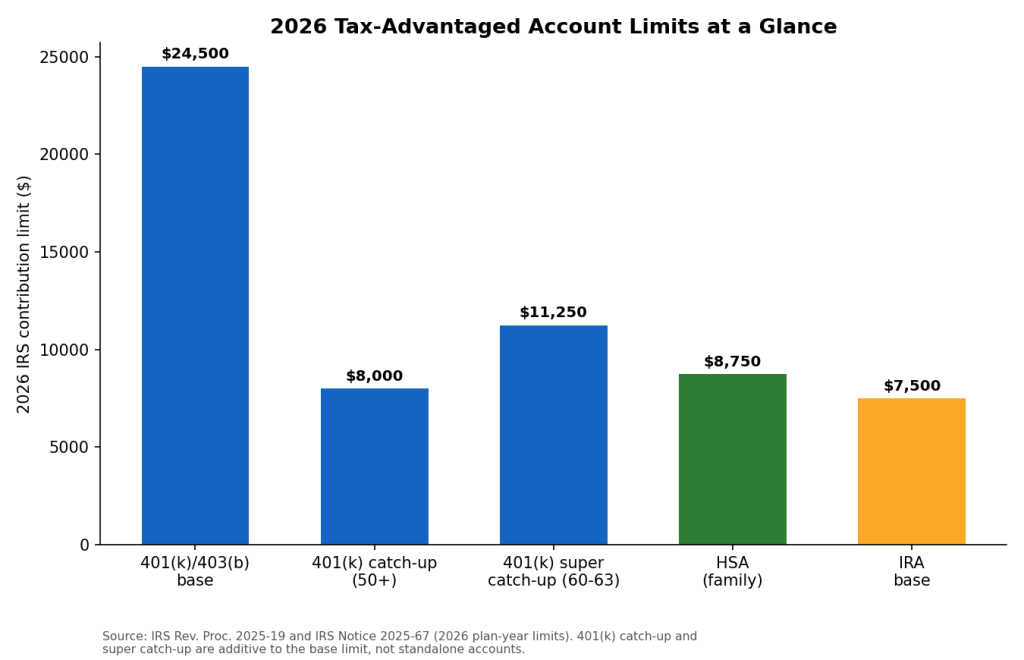
On catch-up contributions: the claim that a higher limit exists starting in 2026 is correct, and more specific than the original phrasing suggests. For 2026: the standard 401(k)/403(b) catch-up for savers 50 and older is $8,000 (on top of the $24,500 base deferral limit), and a “super catch-up” of $11,250 applies specifically to savers who turn 60, 61, 62, or 63 during the year — it replaces, rather than adds to, the standard catch-up, and reverts to $8,000 at age 64. One important 2026 wrinkle the original advice omits: starting this year, any catch-up contribution from a worker whose prior-year wages exceeded $150,000 must go into a Roth (after-tax) account, not pre-tax, under SECURE 2.0.
2. The Tax-Advantaged Account Stack — Confirmed, Standard Practice

The suggested priority order (match → HSA → IRA → additional 401(k) → taxable brokerage) matches conventional financial-planning practice and is grounded in a real tax-efficiency argument, not just convention: the HSA genuinely is the only U.S. account offering a “triple” tax advantage (pre-tax in, tax-free growth, tax-free qualified withdrawals), which is why many planners treat it as a stealth retirement account once medical bills are paid out of pocket.

2026 limits, confirmed: HSA contribution limits are $4,400 (self-only) and $8,750 (family), with a $1,000 catch-up at age 55+; the 401(k) figures are as above; the IRA base limit for 2026 is $7,500, with a $1,100 catch-up at 50+.
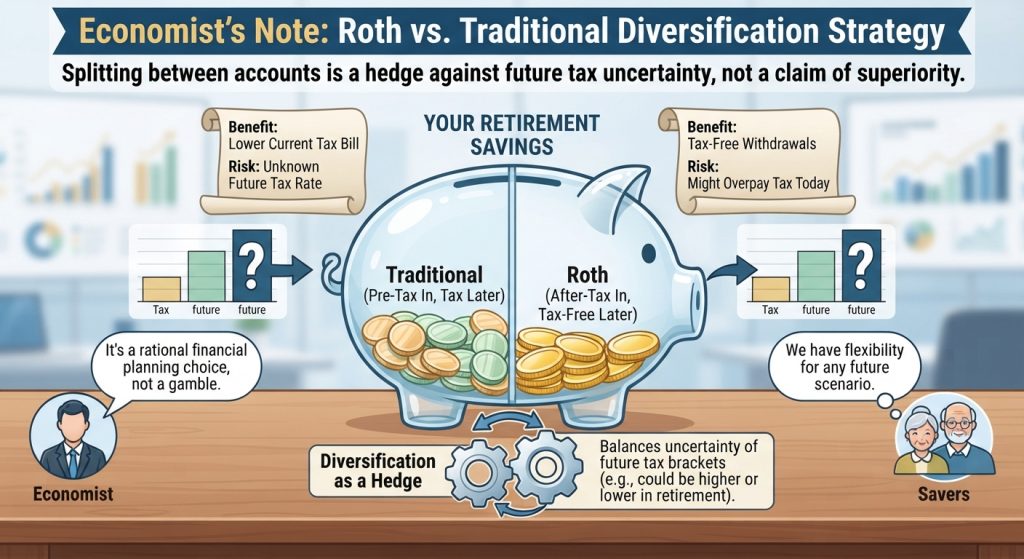
Economist’s note on Roth/Traditional diversification: the advice to split between Roth and Traditional accounts to hedge future tax-rate uncertainty is a legitimate, commonly cited strategy — it is a hedge against not knowing your future marginal tax bracket, not a claim that one account type is objectively superior.
3. Investment Principles — Mostly Sound, One Rule of Thumb Needs a Label

Low-cost index funds, broad diversification, and infrequent trading are all well-supported by decades of empirical finance research (this is close to a consensus view among academic financial economists, following work going back to Bogle, Fama, and French on costs and market efficiency). Avoiding market-timing and excessive trading is likewise well-documented as a persistent source of underperformance for individual investors.

One flag: the “stock allocation = 110 or 120 minus your age” formula is a popular heuristic, not an empirical rule. It has drifted upward over the decades (it used to be “100 minus age”) mainly because life expectancy has lengthened and because a lower-rate environment pushed advisors toward more equity exposure — not because of a new finding about optimal risk-taking. Target-date funds, which the original text also recommends, use their own often more conservative glide paths and are a reasonable way to avoid relying on this rule of thumb at all.
4. Delaying Social Security — Correct, With an Important Return Caveat

The 8%-per-year delayed retirement credit for waiting past Full Retirement Age (FRA) until 70 is accurate and confirmed directly from SSA rules (two-thirds of 1% per month, codified in 42 U.S.C. §402(w)). For someone with an FRA of 67, waiting to 70 raises the monthly benefit to 124% of the FRA amount.


Economist’s caveat, and this is the one place the original advice oversells the number: the 8% figure is often described as a “guaranteed 8% return,” but that framing is misleading. It’s simple, non-compounding interest, and — critically — it comes at the cost of giving up three years of monthly checks while waiting. Once you account for the foregone payments, the actual internal rate of return on delaying is meaningfully lower than 8%, and the breakeven age (the point at which cumulative lifetime benefits from delaying overtake cumulative benefits from claiming early) typically falls in the low-to-mid 80s — meaning delaying is a good bet for someone in good health with family longevity, and a weaker one for someone with health concerns or a shorter expected lifespan. The advice to coordinate spousal claiming strategy is also correct and important: spousal benefits do not earn delayed credits on their own, but survivor benefits do inherit the higher earner’s delayed credits — which is why it usually makes sense for the higher earner in a couple to be the one who delays as Part 4 explains in more depth, the break-even age typically falls in the late-70s to mid-80s.
5. Estimating Post-Retirement Spending — Directionally Reasonable, But Oversimplified

The “70–80% of current spending” rule of thumb is a standard, widely cited industry benchmark (used by Fidelity, AARP, and others) and a reasonable starting point. Where a retirement-income economist would push back: peer-reviewed research on actual retiree spending (notably work on the “retirement spending smile” by researchers such as David Blanchett) finds that real spending is not flat as a percentage of pre-retirement income — it typically declines in real terms through the early-to-mid retirement years as travel and discretionary spending taper off, then rises again later due to healthcare and long-term care costs. A single flat percentage is a fine planning starting point, but it can understate late-life healthcare risk if used uncritically — which is exactly why the original advice’s instruction to budget healthcare and long-term care separately, rather than folding it into a flat percentage, is the more important piece of guidance here.
For a full breakdown of where each account type fits in a broader portfolio, see Part 5.
6. Debt Payoff and Emergency Funds First — Confirmed, Behaviorally Grounded

Prioritizing high-interest debt payoff over additional retirement saving is sound math in almost all cases: credit card APRs (typically in the 20%+ range) exceed any reasonable expected market return, making payoff a better guaranteed “return” than further investing. The 3–6 months’ expenses emergency-fund guideline is standard financial-planning practice, and it’s also empirically the right lever for the “leakage” problem: research from Vanguard and others directly ties the recent rise in 401(k) hardship withdrawals to insufficient emergency savings, which supports treating an emergency fund as a prerequisite for retirement investing, not a competing priority.
7. Flexible/Phased Retirement — Confirmed, Well-Documented Effect

Working even one or two additional years — full-time, part-time, or as a consultant — has an outsized effect on retirement security for a simple, well-documented reason: it simultaneously shortens the drawdown period, lengthens the accumulation period, delays Social Security claiming (compounding point 4 above), and often extends employer health coverage, reducing pre-Medicare healthcare cost exposure. This is one of the more robust findings in retirement-planning research and is not overstated in the original advice.
8. Annual Review — Confirmed, Standard Practice

Reviewing savings rate, asset allocation, and progress toward goals annually — and after major life events — is uncontroversial financial-planning practice with no meaningful economist dissent. The suggestion to use a fee-only advisor (paid a flat fee or hourly rate rather than a commission or percentage of assets) is also consistent with a large body of research on how commission-based compensation can create conflicts of interest in financial advice.
How to Prepare for Retirement in America — Bottom Line

This playbook holds up well under scrutiny — nearly every specific number and priority ordering is consistent with current IRS and SSA rules and with the retirement-planning research literature. The corrections worth keeping in mind: the “110/120 minus age” allocation rule and the “70–80% of spending” retirement-income target are useful heuristics, not empirical laws, and the Social Security “8% guaranteed return” framing overstates the true return once foregone payments are accounted for. None of these caveats undermine the core strategy — they just mean the plan should be treated as a starting framework to personalize, not a formula to apply mechanically.
Sources: IRS Revenue Procedure 2025-19 and Notice 2025-67 (2026 contribution limits); Social Security Administration, Publication No. 05-10147 and 42 U.S.C. §402(w) (delayed retirement credits); Vanguard, How America Saves 2026; Fidelity and AARP retirement-income planning guidance; D. Blanchett, “Exploring the Retirement Consumption Puzzle” and related retirement-spending research.