
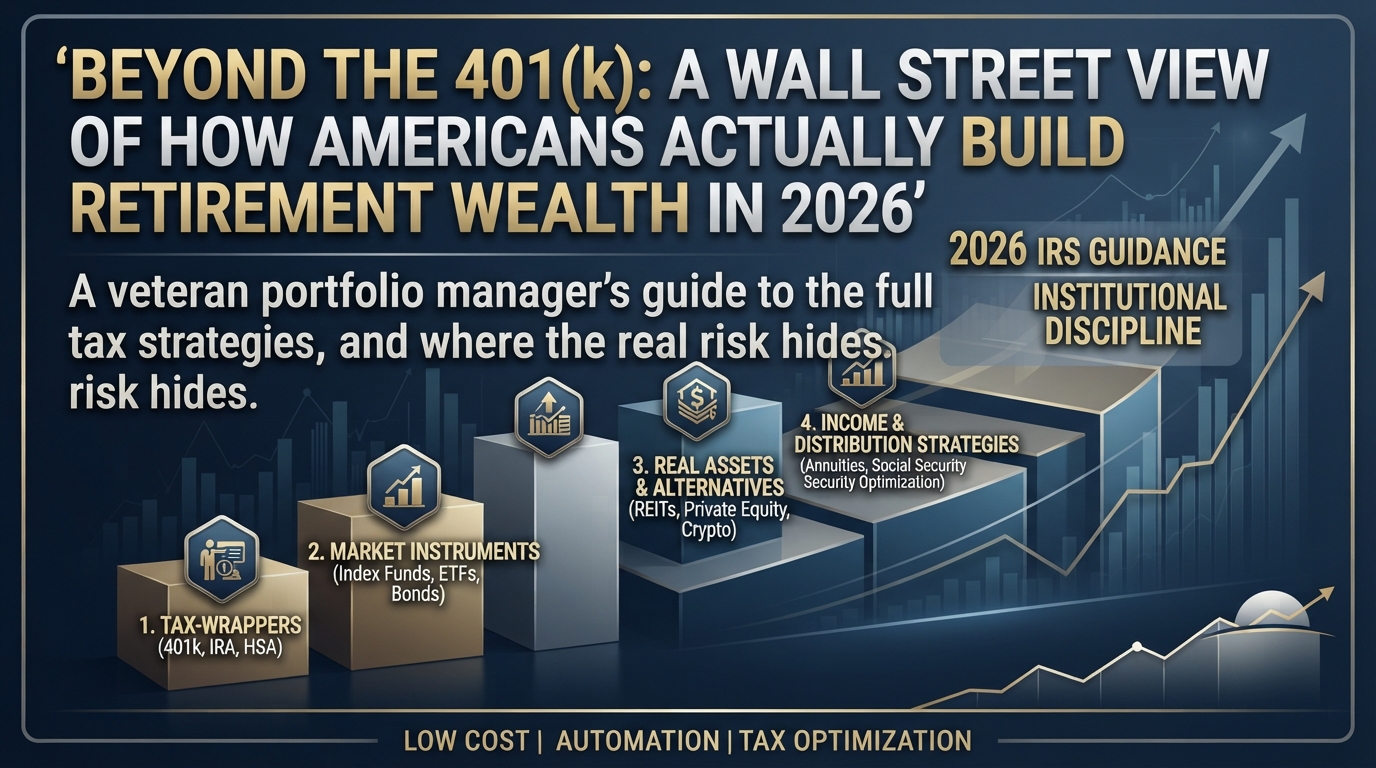
A Wall Street View of How Americans Actually Build Retirement Wealth in 2026
A veteran portfolio manager’s take on the full toolkit — tax wrappers, market instruments, real assets, alternatives, and income strategies — and where the real risk hides.
Every year, a new client walks into my office with the same instinct: “I max my 401(k) and I own an index fund. Am I done?” The honest answer is that the account you use matters almost as much as what you put in it. Retirement planning in the United States isn’t really about picking hot investments — it’s about sequencing tax treatment, liquidity, and risk across everything from your 401(k) to real estate and alternatives. Below is how I’d walk a client through the landscape today, with the numbers checked against current IRS guidance for 2026.
This is the final installment — see Part 1 through Part 4 for the diagnosis; this part is the prescription.
1. Tax-Advantaged Accounts Come First — Always
This is the part clients most underrate. Before a single stock is chosen, the account it sits in should already be doing work.

- 401(k) / 403(b) / 457 plans: The 2026 employee deferral limit is $24,500, with an additional $8,000 catch-up for those 50 and older — bringing the total to $32,500. Employees aged 60–63 get a larger “super catch-up” of $11,250 instead. If your employer matches contributions, that match is an immediate, guaranteed return; I tell clients to capture it before doing anything else.
- Traditional and Roth IRAs: The 2026 contribution limit is $7,500, or $8,600 for those 50 and older. Roth contributions are made after-tax, but qualified withdrawals — including decades of compounded growth — come out tax-free.
- Backdoor and Mega Backdoor Roth: Legitimate, IRS-sanctioned workarounds that let high earners who exceed Roth income limits still get money into Roth-style accounts, either through after-tax IRA conversions or after-tax 401(k) contributions rolled into a Roth.
- HSAs (Health Savings Accounts): Frequently overlooked, and I’d argue the single best-structured account in the tax code — contributions are deductible, growth is tax-free, and withdrawals for medical expenses are tax-free too. The 2026 limits are $4,400 for self-only coverage and $8,750 for family coverage, plus a $1,000 catch-up at 55+. After 65, unused HSA funds can be withdrawn for any purpose penalty-free (ordinary income tax applies, same as a traditional IRA), which effectively makes it a second retirement account.
- SEP IRA / Solo 401(k): For the self-employed, these allow dramatically higher contribution ceilings than a standard IRA — often tens of thousands of dollars more per year.
The professional’s rule of thumb: maximize the available tax-advantaged accounts first, then decide how to invest within them. As Part 3 explains, capturing the full employer match is perhaps the closest thing to a consensus in retirement planning—a rare point on which economists and financial professionals have little to disagree.
2. Traditional Market Exposure — The Core, Not a Sideshow
Once the accounts are chosen, the underlying holdings are usually the boring part — and that’s by design.

- Low-cost index funds and ETFs tracking the S&P 500, total U.S. market, international equities, or the broad bond market remain the backbone of most professionally managed retirement portfolios, simply because costs compound as ruthlessly as returns do.
- Target-date funds automatically shift the mix from stocks toward bonds as the target retirement year approaches — a genuinely useful default for investors who don’t want to manage rebalancing themselves.
- Dividend-growth stocks (the “Dividend Aristocrats” — companies with decades of consecutive dividend increases) are popular for generating income once someone stops working.
- Bond diversification matters more than most retail investors realize: Treasuries, TIPS (inflation-protected), municipal bonds (federally tax-exempt), corporate and high-yield debt, and bond laddering (staggering maturities to manage reinvestment risk) each serve a different job in a portfolio.
3. Real Estate — Without Being a Landlord
Direct rental property is only one route into real estate, and for most people it isn’t the most efficient one.
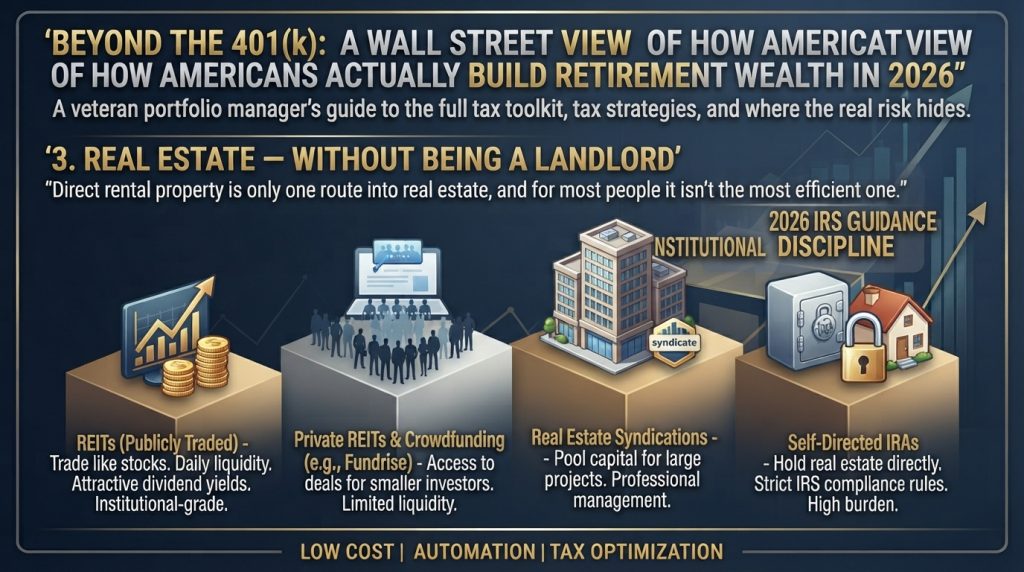
- REITs trade like stocks, offer daily liquidity, and typically carry attractive dividend yields — a genuinely institutional-grade way to hold commercial and residential real estate.
- Private REITs and crowdfunding platforms (Fundrise, RealtyMogul, and similar) let smaller investors buy into commercial or residential deals, though liquidity is far more limited than public REITs.
- Real estate syndications pool capital from multiple investors into a single large project.
- Self-directed IRAs can hold real estate directly, but the IRS rules around prohibited transactions are strict enough that I generally only recommend this route to clients who fully understand the compliance burden.
4. Alternatives — Useful in Small Doses, Dangerous in Large Ones
This is where I get the most questions, and where I give the most pushback.

- Private equity and venture capital can post strong long-run returns, but the capital is illiquid for years, and access typically requires accredited-investor status.
- Private credit / direct lending has grown enormously as banks pulled back from certain types of corporate lending — it offers yields between public bonds and equities, with correspondingly higher risk.
- Infrastructure and real-asset funds, along with commodities and gold, are typically used as inflation hedges rather than growth engines.
- Cryptocurrency, including spot Bitcoin ETFs, has moved from fringe to mainstream enough that some advisors now discuss a small allocation (commonly cited around 5% or less) as a speculative, high-volatility “insurance-like” position — not a core retirement holding.
- Hedge-fund-replication ETFs give retail investors diluted exposure to strategies once reserved for institutions.
My professional caution: alternatives belong at the edges of a retirement portfolio, not the center. Illiquidity and complexity are real costs, even when the headline return looks attractive.
5. Turning Savings Into Income
Accumulating assets is only half the job — converting them into reliable income is the harder half, and it’s where I see the most client anxiety.

- Annuities come in several forms: Single Premium Immediate Annuities (SPIAs) convert a lump sum into guaranteed lifetime income immediately; Deferred Income Annuities and QLACs (Qualified Longevity Annuity Contracts) start payments later, insuring specifically against the risk of outliving your money; fixed, variable, and indexed annuities offer different risk/return trade-offs. Fees and surrender terms vary enormously across products, so this is a category where the fine print matters as much as the concept.
- Covered-call and option-income strategies/ETFs generate extra income by selling call options against stock holdings — trading away some upside for steadier cash flow.
- Preferred stocks and convertible securities sit structurally between common equity and bonds.
6. The Practical Moves That Often Beat Clever Investing
Some of the highest-value decisions in retirement planning aren’t investment choices at all.

- Delaying Social Security to age 70 increases the eventual benefit by roughly 8% per year of delay past full retirement age — a guaranteed, inflation-adjusted return that no market instrument can reliably match, which is why I call it one of the safest “investments” available to American retirees.
- A cash-bucket strategy — holding one to two years of living expenses in high-yield savings, money-market funds, or short-term Treasuries — reduces the need to sell stocks during a downturn.
- Roth conversions during low-income years after retirement (before Social Security and required minimum distributions begin) can meaningfully reduce lifetime tax exposure.
- A side business or passive income stream diversifies income sources beyond the investment portfolio entirely.
A Sample Allocation Framework

The general pattern institutional advisors follow: growth assets dominate earlier in a career, income and stability assets take over as retirement nears, tax efficiency (which account holds which asset) is decided before the asset itself is chosen, and complex alternatives rarely exceed 10–20% of the total portfolio.
The Wall Street Bottom Line

Having spent a career around both institutional and retail portfolios, the pattern holds remarkably consistently: low cost, automation, and tax optimization outperform complexity over a multi-decade horizon. The investors who do best aren’t the ones chasing the newest private-credit fund or the most exotic annuity — they’re the ones who fill their tax-advantaged accounts every year, hold diversified low-cost funds inside them, and resist the urge to overcomplicate. Sophisticated instruments have a place, but usually at the margins, not the foundation.
Figures reflect 2026 IRS contribution limits (401(k)/403(b)/457, IRA, and HSA) as published by the IRS and confirmed against Fidelity, Principal, and Empower guidance. This article is for informational purposes and does not constitute personalized financial or tax advice.