

What the Data Say, and What to Actually Do About It
A fact-check and Western-economist reframing of a popular retirement-planning explainer, written for U.S. citizens

Building on Part 2’s finding that the Social Security OASI trust fund is on track to deplete its reserves in the fourth quarter of 2032 — after which incoming payroll taxes would cover only about 78% of scheduled benefits — this part turns to a related but distinct question: what retirement age in America actually looks like in practice, and how well the original piece’s claims about “working longer” hold up against the data. The original piece makes two central claims: retirement today comes in several flavors — traditional, FIRE, Coast FIRE, Barista FIRE, an “encore career,” or simply working later — and working longer is possible but not guaranteed, since health, ageism, and job type get in the way. Both hold up well against current U.S. data. An economist, though, would tell the story less as a menu of lifestyle choices and more as a set of trade-offs between labor supply, longevity risk, and how Social Security’s incentives are actually built.
What checks out

The 8%-a-year delayed retirement credit is real and correctly described. For anyone born in 1943 or later, Social Security benefits grow by about two-thirds of one percent for every month a person delays claiming past full retirement age (FRA), up to age 70 — an annualized boost of roughly 8%. Waiting the full stretch from FRA to 70 raises the monthly check by about 24%, permanently, on top of ordinary cost-of-living adjustments. The credit stops accruing entirely at 70, so there’s no financial upside to waiting any longer than that.

Health is genuinely the leading reason Americans retire earlier than planned — and the gap is widening. The 2026 EBRI/Greenwald Retirement Confidence Survey found that 46% of retirees left the workforce earlier than they had intended, and among that group, 41% cited a health problem or disability — up sharply from 31% the year before. Corporate restructuring (downsizing, closures, reorganizations) was the second-biggest driver, at 35%. The original article’s claim that health is the single biggest reason people retire earlier than planned is not just correct — it understates how much larger that gap has grown recently.

Age discrimination is illegal in the U.S. but demonstrably still present. The Age Discrimination in Employment Act (ADEA) bars discrimination against workers 40 and older, but audit-style field studies — sending matched fictitious résumés that differ only by applicant age — have repeatedly found lower callback rates for older applicants, especially in physically demanding or fast-changing technical fields. The original article’s caveat here is accurate.

FIRE, Coast FIRE, and Barista FIRE are described correctly, and the risks flagged — extreme savings requirements, gaps in employer-sponsored health coverage before Medicare eligibility at 65, and the psychological cost of losing a sense of purpose — mirror what U.S. financial planners and retirement researchers generally warn about.
The Real Retirement Age in America: Plan vs. Reality — in one chart
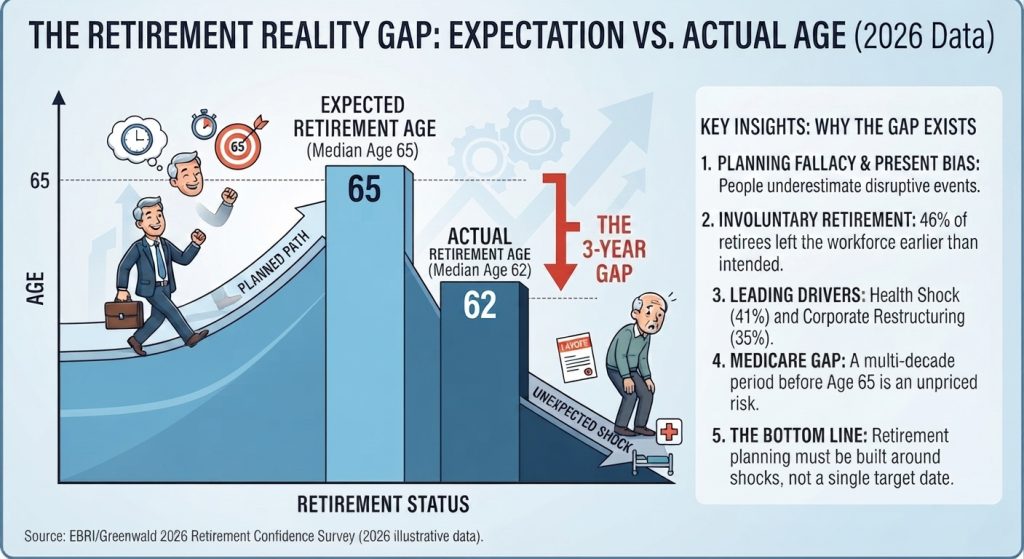
The single most important number in this conversation is the gap between the age American workers expect to retire and the age most of them actually do. This is not a rounding error; it is the central fact retirement economics has to explain.
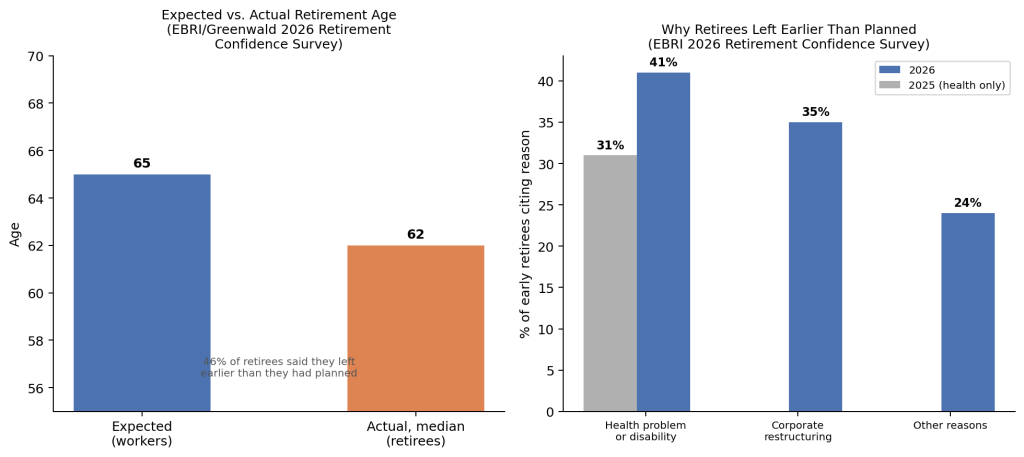
Source: EBRI/Greenwald 2026 Retirement Confidence Survey.
Workers still tell surveyors they expect to work until a median age of 65. Retirees, looking back, report a median actual retirement age of 62 — three years earlier, and for a large share, involuntarily.
Reframing it through a Western-economist lens

1. This is a labor-supply problem, not just a personal-finance problem. Popular retirement content — including the original article — tends to treat “working longer” as a matter of willpower and planning. Labor economists frame it differently: retirement timing is the point where the declining, uncertain value of continued work meets the rising value of leisure and health, shaped heavily by Social Security’s incentive structure. The 8% delayed-credit bump is effectively one of the most generous risk-free “returns” available to a retiree — but it only pays off for someone who can actually keep working or has other income to bridge the gap, which is precisely what a large share of Americans can’t do.

2. The three-year “planning gap” is a textbook behavioral-economics finding, not a personal failure. It lines up with decades of research on the planning fallacy and present bias: people systematically underweight the chance that a disruptive event — a layoff, a health shock — will derail a multi-decade plan. An economist would treat the 46%-retired-early statistic not as evidence Americans are bad planners, but as evidence that retirement planning needs to be built around shocks, not a single target date.

3. FIRE looks less like “financial independence” and more like a bet on front-loaded human capital. From the life-cycle consumption-smoothing framework economist Franco Modigliani built retirement theory on, FIRE only works if a few years of very high savings can substitute for what would otherwise be 30–40 years of earnings and employer-subsidized health insurance. That’s a legitimate strategy for high, stable earners — but it’s a concentrated bet, not a general-purpose plan, and the multi-decade gap before Medicare eligibility at 65 is the single largest unpriced risk in the model.

4. “Semi-retirement” is where U.S. labor-market research and policy increasingly converge. Phased or bridge employment — moving from full-time to part-time, consulting, or lower-intensity roles rather than stopping abruptly — is what workers say they want (EBRI surveys find close to half hope for a gradual transition), but firms rarely structure jobs to offer it: three in four retirees report they in fact stopped working all at once. That mismatch between worker preference and employer practice, more than a lack of individual willpower, is the real barrier to “working longer” as a broad-based strategy.

5. Delaying Social Security is longevity insurance, not a savings strategy. The break-even age for delaying benefits from 67 to 70 typically falls in the late-70s to mid-80s. Whether that trade pays off depends entirely on how long a person lives — something large risk pools price efficiently (that’s what an annuity is) but that individuals routinely misjudge for themselves. Framed this way, delaying Social Security is one of the few longevity-insurance products an ordinary household can buy directly from the U.S. government as Part 5 frames it from a portfolio-manager’s view, this is one of the safest guaranteed returns available.
What this means in practice for a U.S. citizen
Translating the economics into concrete 2026 numbers and rules:

- Social Security claiming window: Full retirement age is 66–67 depending on birth year. Claiming at 62 permanently cuts the monthly benefit by roughly 30%; waiting to 70 raises it by roughly 24% above the FRA amount, and the credit stops accruing at 70 — there is no reason to wait past that age.
- Medicare eligibility: Coverage doesn’t start until 65, regardless of Social Security claiming age. Anyone retiring before 65 needs a bridge — COBRA continuation coverage (typically available for up to 18 months after leaving an employer plan), a spouse’s employer plan, or an ACA marketplace plan — since this multi-year gap is exactly where FIRE- and early-retirement plans tend to break.
- Catching up on savings in your 50s and early 60s: 2026 contribution limits give older workers real room to close a shortfall — the 401(k)/403(b) employee limit is $24,500, with an $8,000 catch-up for those 50+, and a larger $11,250 “super catch-up” for ages 60–63. The IRA limit is $7,500, plus a $1,100 catch-up for those 50+.
- Legal protections if age discrimination is suspected: The ADEA covers employers with 20+ employees; a worker who believes they were pushed out or passed over because of age can file a charge with the Equal Employment Opportunity Commission (EEOC), which is a required first step before suing under federal law.
- Phased retirement, concretely: Ask whether your employer has a formal phased-retirement or “retiree consulting” arrangement before assuming you have to choose between full-time work and full stop — EBRI data suggests this is what most workers actually want, even though most employers don’t offer it by default.
The bottom line

The original article’s factual claims — the 8% credit, health as the top driver of early retirement, the presence (if illegal nature) of age discrimination, and the descriptions of FIRE/Coast FIRE/Barista FIRE — all check out against current U.S. data. Where a Western economist would push back is on framing: “working longer” is less a matter of personal discipline than of whether your health holds, whether your employer offers a phased path out, and whether you can absorb a shock you didn’t plan for. For a U.S. citizen specifically, the practical takeaway is to treat 65 (Medicare) and the FRA-to-70 window (Social Security) as the two hard pivot points to plan around, use the 50+/60–63 catch-up contribution rules aggressively in the decade before either date, and — as the original article recommends — put health and job flexibility first, since those, not willpower, are what actually determine whether “working longer” stays a choice.
Sources: Social Security Administration delayed retirement credit rules (2026); EBRI/Greenwald 2026 Retirement Confidence Survey; IRS Notice 2025-67 (2026 retirement plan contribution limits); Kiplinger, “Six Changes to Social Security in 2026.”
IRS Notice 2025-67 – 401(k) limit increases to $24,500 for 2026, IRA limit increases to $7,500 : https://www.irs.gov/newsroom/401k-limit-increases-to-24500-for-2026-ira-limit-increases-to-7500