
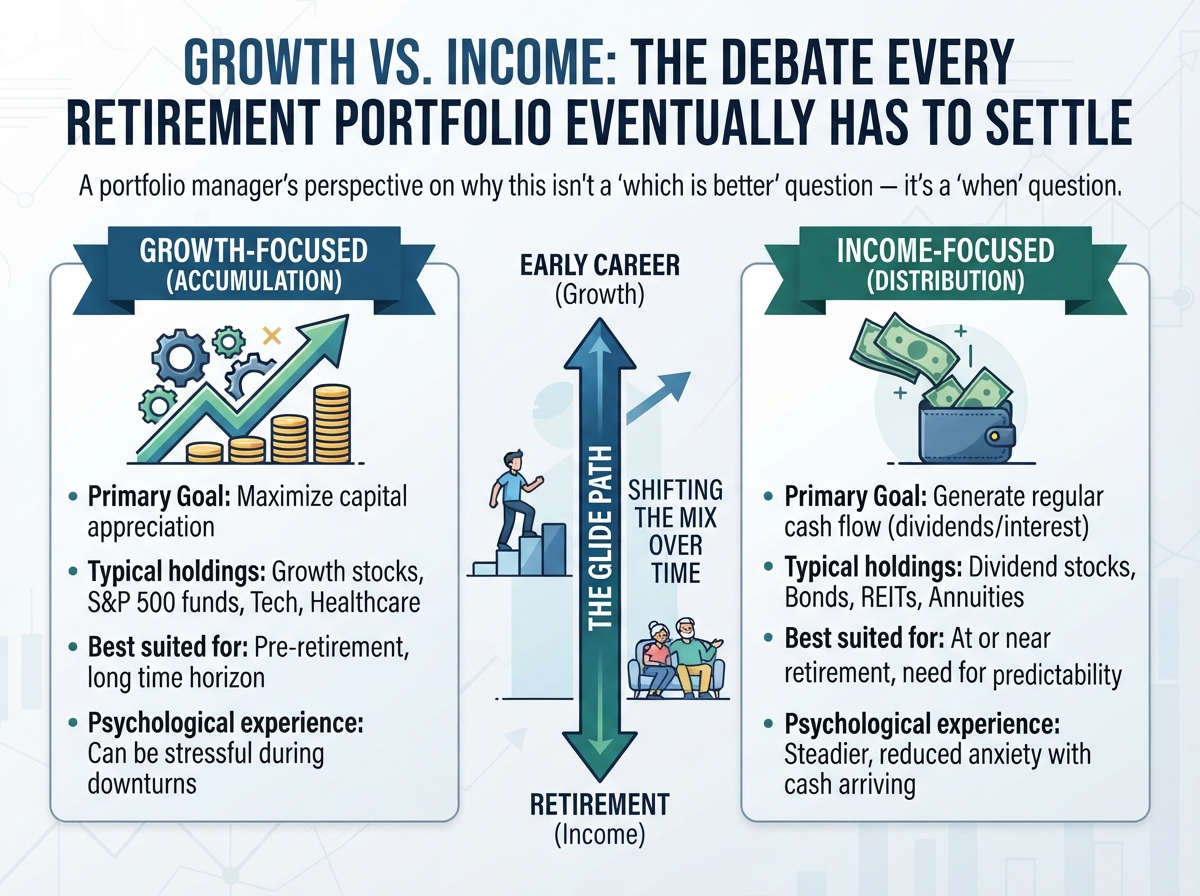
The Debate Every Retirement Portfolio Eventually Has to Settle
A portfolio manager’s perspective on why this isn’t a “which is better” question — it’s a “when” question.
Clients tend to arrive at this question in one of two moods. Younger clients ask, half-defensively, “Should I even bother with dividend stocks?” Clients approaching retirement ask the opposite: “Should I start selling my growth stocks and buying something that pays me?” Both questions miss the more useful framing. Growth and income aren’t competing philosophies — they’re tools suited to different phases of a financial life, and the real skill is knowing when to shift the mix.
This picks up where Part 5’s toolkit of tax wrappers and income strategies left off.
The Core Trade-Off

Growth-Focused Investing: Building the Pile
The objective here is straightforward — grow the total size of the portfolio over time, and worry about converting it to income later.
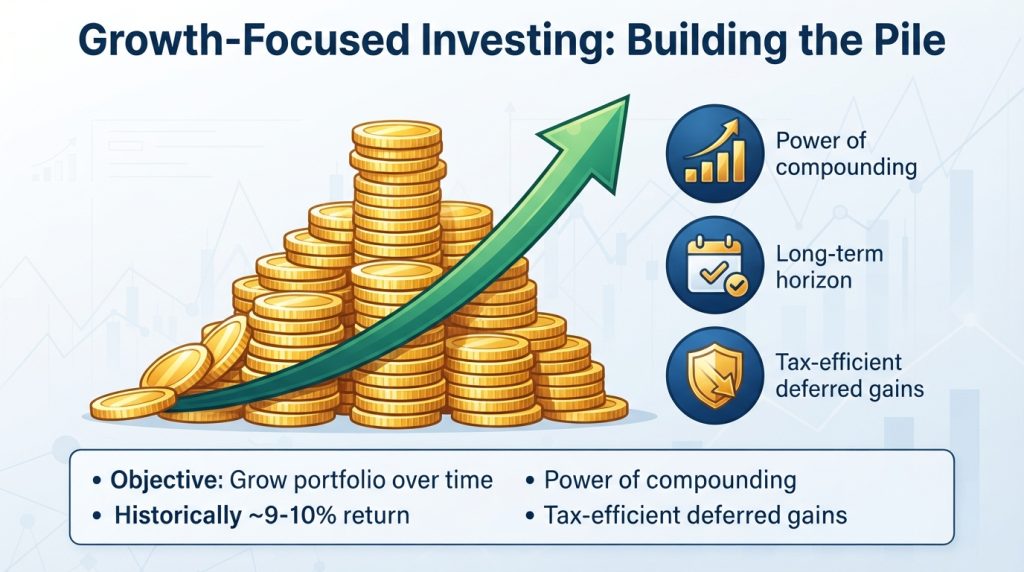
Why it works: Historically, U.S. equities have delivered roughly a 9–10% nominal annualized return over the long run (Fidelity puts the 30-year S&P 500 average near 10.4%, and multiple sources place the 100-year figure around 10.5%). Left alone, compounding does most of the heavy lifting, and because the gains are unrealized until sold, taxes are deferred rather than owed annually.

Where it hurts: The same volatility that builds wealth also creates what professionals call sequence-of-returns risk — the danger that a market decline hits right as someone begins withdrawing for living expenses. Selling depreciated shares to cover expenses locks in losses and can permanently impair a portfolio’s ability to recover, even if the market eventually rebounds. This is a mathematically real risk, not just a psychological one — it’s a large part of why “just stay all-growth forever” doesn’t survive contact with actual retirement withdrawals.
Retirement researcher Wade Pfau, who co-developed the “rising equity glide path” concept with Michael Kitces, found that starting retirement more conservatively and gradually increasing stock exposure can actually reduce both the odds and severity of portfolio failure — the opposite of the conventional wisdom that equity exposure should only decrease with age.

Best fit: Investors ten-plus years from retirement, those with other income sources (a salary, future Social Security), and anyone who can genuinely tolerate volatility without selling at the wrong time.
For a broader look at how U.S. retirement savers actually build wealth across accounts, see Part 5 – Beyond the 401(k).”
Income-Focused Investing: Living Off the Yield
The philosophy here is often summarized as “eat the eggs, don’t touch the hen” — draw living expenses from dividends and interest, leaving the principal largely intact.

Why it works: A steady stream of cash reduces the psychological pressure to sell assets during a downturn, which directly mitigates sequence risk. It also makes retirement budgeting more predictable — a fixed income stream is easier to plan around than a fluctuating account balance.

Where it hurts: Income-focused portfolios generally produce lower total returns over long horizons than growth portfolios, particularly if the strategy chases yield without regard for underlying growth. High-dividend stocks and high-yield bonds carry real credit and cut risk — dividends get slashed during recessions more often than investors expect. And in a taxable account, dividends and interest are taxed annually as they’re received, which is less tax-efficient than deferred capital gains. Portfolios weighted toward fixed-rate income can also lag inflation over time.
Not every practitioner agrees dividend-focused investing deserves its popularity. Ben Felix of PWL Capital, drawing on the Miller-Modigliani dividend irrelevance framework, points out that a dividend payout is economically just a forced sale of part of your position — the stock price drops by the dividend amount, so nothing is actually “earned” that wasn’t already there. His view: total-return investing captures the same cash flow more tax-efficiently, without the added risk of concentrating in dividend-paying sectors.

Best fit: Retirees or near-retirees, anyone prioritizing predictable cash flow, and investors who are especially sensitive to market swings.
If Social Security’s funding timeline factors into your income planning, Part 2 covers the structural pressures in detail.
What the Institutional Research Actually Says

Asset managers including BlackRock, Fidelity, and Morningstar converge on a similar conclusion: growth should dominate the accumulation years, but a pure-growth approach becomes riskier once withdrawals begin. A portfolio that’s 100% growth going into a bear market can suffer serious, lasting damage to its principal; a portfolio that’s 100% income risks failing to keep pace with inflation and capping long-term growth. The practical answer most professionals land on is a hybrid:
As explored in Part 3’s fact-checked playbook, most standard retirement advice holds up — but the growth/income mix is where it gets nuanced.

- Cover part of living expenses with dividends and interest (the income sleeve)
- Keep the remainder invested for long-term growth
- Or use a total-return approach — treat capital gains and income interchangeably, and withdraw only what’s needed from the blended total (the well-known “4% rule” is one version of this framework, though most professionals today treat 4% as a starting point rather than a guarantee)
Christine Benz, Morningstar’s director of personal finance and retirement planning, has long argued that where your cash flow comes from matters less than how much you’re withdrawing overall — dividends and capital gains are functionally interchangeable as long as total withdrawals stay reasonable. She’s also a prominent advocate of the “bucket” method: pairing a total-return portfolio with a cash reserve of one to two years of expenses, so retirees never have to sell depressed assets to cover near-term spending.
Sample Portfolio Structures
How much should I have in dividend stocks before retirement?

- Growth-oriented: 80–90% equity index funds, 10–20% bonds
- Income-oriented: Dividend-stock ETFs + bonds + REITs + a smaller high-yield sleeve, generally targeting a blended yield in the 3.5–5% range
- Balanced (the most common in practice): 50–60% equities (including dividend payers), 30–40% bonds, roughly 10% REITs/alternatives
The Professional’s Verdict

There is no version of this debate where one approach is categorically correct — the honest answer is that it’s a function of time horizon, not preference. Young investors with a long runway are almost always better served leaning hard into growth; the math of compounding rewards patience more than it rewards yield-chasing. As retirement nears, shifting weight toward income-generating assets isn’t a concession — it’s risk management, specifically against the sequence-of-returns problem that pure-growth portfolios can’t fully protect against.
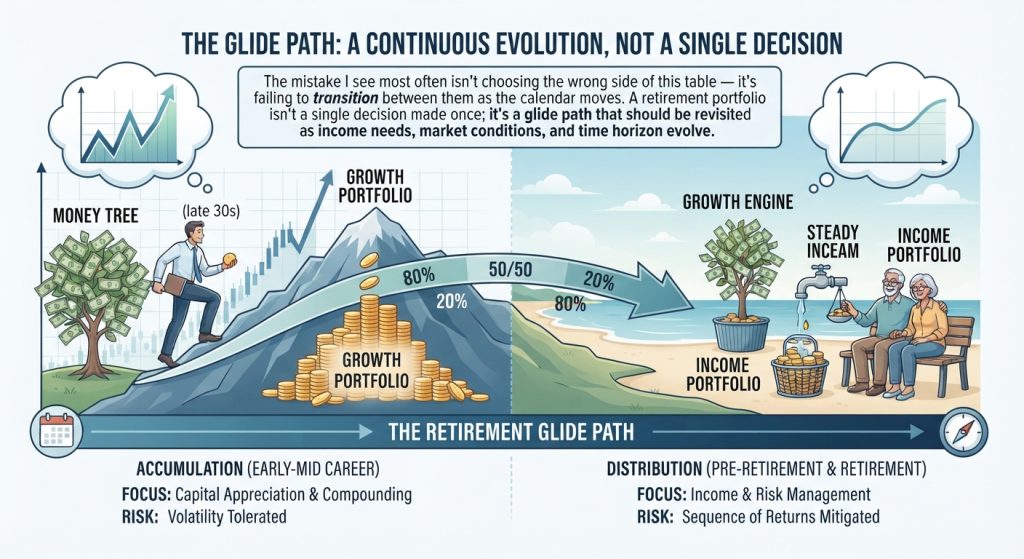
The mistake I see most often isn’t choosing the wrong side of this table — it’s failing to transition between them as the calendar moves. A retirement portfolio isn’t a single decision made once; it’s a glide path that should be revisited as income needs, market conditions, and time horizon evolve.
If you’re just starting to map out where you stand, Part 1 and Part 4 are good starting points.
Historical return figures reflect long-run S&P 500 nominal averages as reported by Fidelity and other industry sources (approximately 9–10.5% annualized over 30- and 100-year periods). This article is for informational purposes and does not constitute personalized investment or tax advice.